
Study Materials
Making of the Constitution
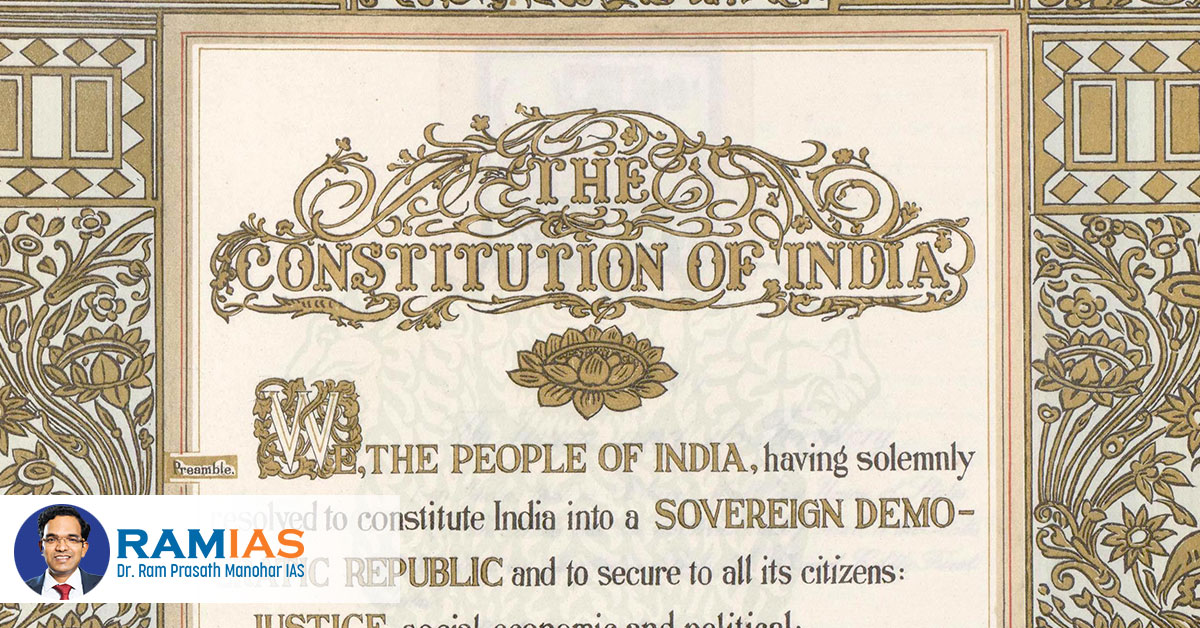
The Constituent Assembly, established in 1946, was responsible for drafting the Indian Constitution and ensuring that it reflected India’s vast cultural, social, and political diversity. Guided by leaders such as Jawaharlal Nehru, Dr. B.R. Ambedkar, and Sardar Vallabhbhai Patel, the Assembly debated major issues—federalism, fundamental rights, governance structures—and laid the foundations of independent India’s constitutional philosophy.
After thorough deliberations, the Constitution was adopted on 26 November 1949 and came into force on 26 January 1950, marking India’s transition into a sovereign republic with a parliamentary democratic system rooted in justice, liberty, equality, and fraternity.
What is a Constituent Assembly?
A Constituent Assembly is a specially created body empowered to draft or revise a Constitution. India’s Constituent Assembly was formed in November 1946 under the Cabinet Mission Plan, with members partly elected and partly nominated.
It first met on 9 December 1946 to prepare an independent Constitution based on the principle of self-determination.
After completing its task on 24 January 1950, the Assembly continued as the Provisional Parliament until the first general elections of 1951–52.
Historical Background
The demand for an Indian-made Constitution emerged from growing dissatisfaction with British constitutional schemes like the Government of India Acts of 1919 and 1935, which offered limited autonomy but retained British control over key subjects such as defence, finance, and foreign affairs.
National leaders like Gandhi, Nehru, and Ambedkar argued that only a Constitution written by Indians could truly represent the nation’s social, cultural, and political aspirations.
Key Milestones
|
Year |
Development |
|
1934 |
M.N. Roy first proposed the idea of a Constituent Assembly. |
|
1935 |
The Indian National Congress demanded a Constituent Assembly. |
|
1938 |
Nehru declared that free India’s Constitution must be framed without external interference and on adult franchise. |
|
1940 |
The British accepted the idea in principle in the August Offer. |
|
1942 |
The Cripps Mission proposed an elected Constituent Assembly; the Muslim League rejected it. |
|
1946 |
The Cabinet Mission Plan finalized the structure and elections for the Assembly. |
Composition of the Constituent Assembly
Total strength: 389
- 296 from British Indian provinces
- 93 from princely states
After the Muslim League withdrew, the numbers reduced:
- British India seats: 229
- Princely states seats: 70
Election Process
- Provincial representatives were indirectly elected by newly elected members of provincial legislative assemblies.
- Seats were allocated to Muslims, Sikhs, and the General communities based on population.
- Voting: Proportional Representation with Single Transferable Vote (STV).
- Members from princely states were nominated by their rulers.
Making of the Indian Constitution: Timeline
|
Date |
Event |
|
9 Dec 1946 |
First meeting of the Constituent Assembly |
|
11 Dec 1946 |
Dr. Rajendra Prasad elected President; B.N. Rau appointed Constitutional Advisor |
|
13 Dec 1946 |
Nehru introduced the Objective Resolution (philosophical foundation of the Constitution) |
|
22 Jan 1947 |
Objective Resolution adopted |
|
July 1947 |
The Indian Independence Act gives full autonomy to the Assembly + legislative powers |
|
22 July 1947 |
National Flag adopted |
|
Oct 1947 – Feb 1948 |
Drafting Committee prepares the first draft (315 Articles, 8 Schedules) |
|
4–9 Nov 1948 |
First reading of the Draft Constitution |
|
15 Nov 1948 – 17 Oct 1949 |
Clause-by-clause discussion (Second reading) |
|
14–26 Nov 1949 |
Third reading completed |
|
26 Nov 1949 |
Constitution adopted (Constitution Day) |
|
24 Jan 1950 |
Dr. Rajendra Prasad elected first President of India; National Anthem & Song adopted |
|
26 Jan 1950 |
Constitution enforced (Republic Day) |
When Did the Constitution Come Into Force?
Although adopted in November 1949, the Constitution came into full effect on 26 January 1950, chosen to honour the 1930 Poorna Swaraj Declaration.
Some transitional provisions (e.g., citizenship, elections, provisional Parliament) came into effect on 26 November 1949.
Committees of the Constituent Assembly
- Organizational Committees
|
Committee |
Chairperson |
|
Rules of Procedure |
Rajendra Prasad |
|
Steering Committee |
Rajendra Prasad |
|
Staff & Finance |
Rajendra Prasad |
|
Credentials |
A.K. Ayyar |
|
Order of Business |
K.M. Munshi |
|
States (Negotiating) Committee |
Jawaharlal Nehru |
|
Flag Committee |
Rajendra Prasad |
|
Committee on Functions of CA |
G.V. Mavlankar |
- Principal Committees
|
Committee |
Chairperson |
|
Advisory Committee on Fundamental Rights, Minorities, Tribal & Excluded Areas |
Sardar Patel |
|
Union Powers Committee |
Jawaharlal Nehru |
|
Union Constitution Committee |
Jawaharlal Nehru |
|
Provincial Constitution Committee |
Sardar Patel |
|
Drafting Committee |
Dr. B.R. Ambedkar |
- Sectoral Committees
|
Committee |
Chairperson |
|
Ad-hoc Committee on Citizenship |
S. Varadachariar |
|
Committee on Chief Commissioners’ Provinces |
N. Gopalaswami Ayyangar |
|
Experts Committee on Financial Provisions |
N.R. Sarkar |
|
Sub-committee on Minority Safeguards (WB & East Punjab) |
Sardar Patel |
Criticism of the Constituent Assembly
- Not fully representative: Not elected by universal adult franchise.
- Not sovereign initially: Born out of the British Cabinet Mission Plan.
- Slow process: Took 2 years, 11 months, compared to 4 months for the U.S. Constitution.
- Dominated by Congress: Granville Austin said, “The Assembly was one-party in a one-party nation.”
- Lawyer-politician dominance lacking wider social representation.
- Hindu-majority character: Criticized by leaders like Winston Churchill.
Despite these criticisms, the Assembly is widely regarded as a gathering of India’s finest minds, producing one of the most comprehensive and stable Constitutions in the world.
