
Study Materials
General Studies - Modern History
Development of the Mughal Empire
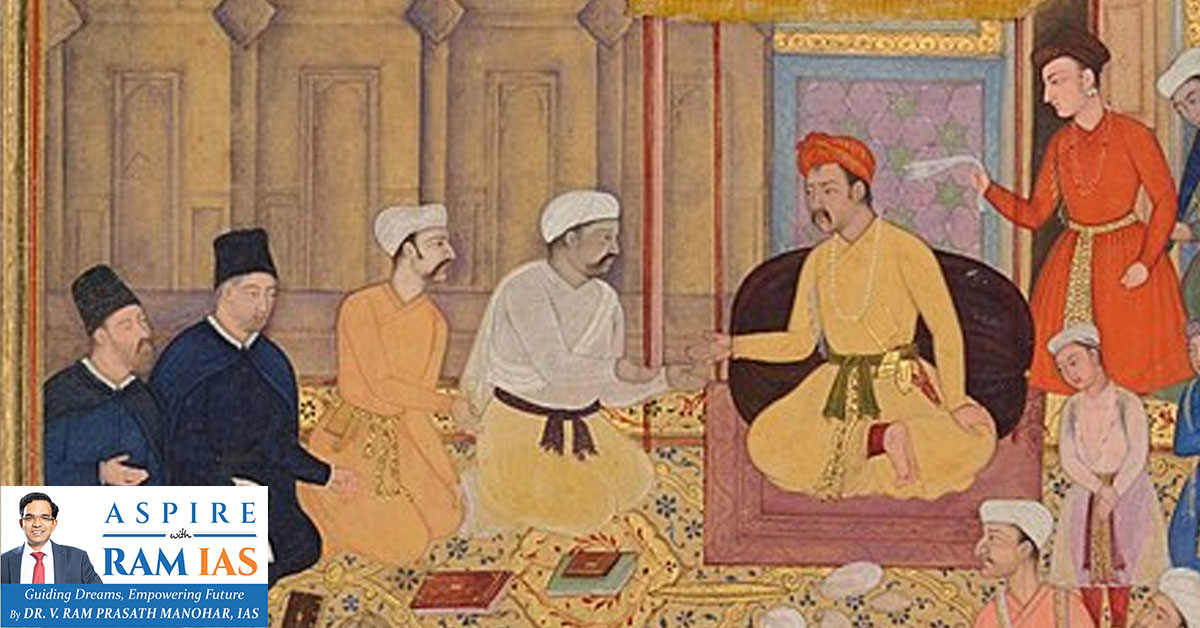
Origin of the Mughals
- Mughals = derived from Mongols
- Genghis Khan united Mongol tribes → established the Mongol Empire (13th–14th century).
- Timur, a Barlas Turk, claimed descent via marriage and declared sovereignty.
- Babur, descendant of Genghis Khan, founded the Mughal Empire by defeating Ibrahim Lodi in the First Battle of Panipat (1526).
Babur (1526–1530)
Background
- Timur had annexed parts of Punjab; Babur saw these as his rightful inheritance.
- Looked to India for wealth, refuge, and a base against the Uzbeks.
- Invited by Daulat Khan Lodi and Rana Sanga to invade India.
Major Battles
- Panipat (1526) – Babur defeats Ibrahim Lodi.
- Khanwa (1527) – Defeats Rana Sanga; secured Delhi–Agra region.
- Chanderi (1528) – Defeats Medini Rai; captures Chanderi.
- Ghaghara (1529) – Campaign against Afghans; truce allowed them to rule Bihar.
Other Points
- Died 26 December 1530.
- An orthodox Sunni but not a bigot.
- Wrote Tuzuk-i-Baburi (Turkish).
Significance of His Conquest
- Brought Kabul & Qandhar into the North Indian empire → secured the NW frontier.
- Increased India’s trade with China and the Mediterranean.
- Defeat of Lodis + Rajput confederacy → foundation of an all-India Mughal Empire.
- Popularised artillery & gunpowder warfare.
- Built a strong crown-centric state.
Humayun (1530–1540; 1555–1556)
Challenges
- Infant empire consolidation.
- The Timurid tradition of dividing the empire among brothers.
- Afghan hostility.
- Threat of Bahadur Shah of Gujarat.
Campaigns
- Defeated Bahadur Shah; briefly held Gujarat & Malwa; lost soon after.
- Sher Shah rose while Humayun was in Gujarat.
Defeat
- Battle of Kannauj (1540) → Sher Shah defeated Humayun.
- Humayun became a king without a kingdom; fled to Iran.
Reasons for Defeat
- Misjudged Afghan unity under Sher Shah.
- Faulty Bengal campaign.
- No support from brothers.
Return
- With the Sur empire’s breaking (1555), he recovered Delhi.
- Died in 1556 from a fall.
- Tomb built by Bega Begum.
Sur Empire (1540–1555)
Sher Shah (1540–1545)
- Ruled the strongest empire since Muhammad bin Tughlaq.
- Added Malwa, Rajasthan.
- Succeeded by Islam Shah (till 1553).
- Succession struggles → fall of the Sur rule.
Sher Shah’s Contributions
- Restored law and order.
- Improved communication networks; rebuilt the Grand Trunk Road.
- Built sarais & inns → many became qasbas.
- Currency reforms, standard weights & measures.
- Land revenue system:
- Measured sown land.
- State’s share = one-third of the average produce.
- Sasaram tomb = culmination of Sultanate style, start of new Mughal style.
Akbar (1556–1605)
Expansion
- Won the Second Battle of Panipat (Bairam Khan vs Hemu).
- Conquered Ajmer, Malwa, Garha-Katanga, Rajasthan, Gujarat, Bengal.
- Rebellions in 1580–81 were suppressed by Todar Mal, Man Singh, etc.
Frontier & Deccan Policy
- Secured the North-West frontier due to the Uzbek threat.
- Captured Odisha, Dacca → political integration of North India.
- Entered Deccan due to:
- Sectarian rivalries,
- Portuguese activities & proselytization.
- Captured Khandesh (1601), Berar, Ahmadnagar, and parts of Telangana.
Akbar’s Land Revenue System
Dahsala / Zabti
- 10-year average of produce + prices calculated.
- State share = one-third, paid in cash.
- Linked with Todar Mal.
Other Systems
- Batai/Ghalla-bakshi: divide produce in proportion; cash or kind.
- Nasaq: another assessment method.
- Taccavi loans for peasants.
- Land classified by quality.
Mansabdari System
- Officers allotted ranks (mansab) from 10 to 5000 (later 7000).
- Rank determined:
- Zat (personal status),
- Sawar (cavalry quota).
- Maintained 2 horses per cavalryman.
- Paid via jagirs or sometimes in cash.
- Crucial for both the army organisation and the nobility structure.
Rajput Policy
- Continued Humayun’s alliance policy.
- Matrimony is not compulsory.
- Only Mewar (Rana Pratap) resisted.
- Rajputs were treated at par with Mughal nobles.
- Cemented by religious tolerance.
- Continued by Jahangir & Shah Jahan.
Religious Policy
- Based on sulh-i-kul — universal toleration.
- Built Ibadat Khana (1575) at Fatehpur Sikri.
- Attempted Tauhid-i-Ilahi (Divine Monotheism).
- Reforms:
- Restricted sati; widow remarriage legalized.
- Marriage age → girls 14, boys 16.
- Restricted wine & spirits.
- Revised education → moral & secular subjects.
Jahangir (1605–1627)
Achievements
- Settled the Mewar dispute; strengthened Rajput alliance.
- Subjugated the Deccan but avoided deep involvement.
- Suppressed the Afghan rebellion in Bengal.
Issues
- Persia captured Qandhar.
- Shah Jahan refused to go → rebelled due to court intrigues.
- Jahangir’s declining health further weakened control.
Shah Jahan (1628–1658)
Deccan Policy
- Needed control over Ahmadnagar → sought alliance with Bijapur.
- Bijapur later switched sides → Mughals failed.
- Shifted focus to Bijapur; later, both signed the Treaty of 1636.
- Mughal suzerainty was established in the Deccan.
- The rise of Shahji and Shivaji + Golconda nobles, kept the region unstable.
- Arrival of Aurangzeb as Deccan viceroy deepened the crisis.
Administration
- Akbar’s system largely continued.
- Mansabdari modified:
- Jahangir: introduced du-aspah sih-aspah.
- Shah Jahan: reduced troop numbers due to financial stress.
- Despite issues, the system worked due to strong wazirs.
Aurangzeb (1658–1707)
Accession
- Won the succession war; imprisoned Shah Jahan.
Empire
- The Mughal Empire reached its maximum territorial extent.
- From Kashmir → Jinji, Hindukush → Chittagong.
Religious & Social Policies
- Orthodox Sunni.
- Demolished temples; re-imposed jizyah (1679) → resentment.
- The Rajput alliance weakened due to harsh policies in Marwar & Mewar.
Conflicts
- Fought Jats, Afghans, Sikhs.
- Gave Marathas space during the crucial phase of consolidation.
Deccan Campaign (1681–1707)
- Defeated Bijapur & Golconda.
- The occupied parts of the Maratha territory were occupied, but the Marathas were not subdued.
Death
- Died 1707 → empire internally strained and destabilised.
MCQs
- Babur’s defeat of Ibrahim Lodi in 1526 is associated with which battle?
A) Battle of Khanwa
B) Battle of Panipat
C) Battle of Ghaghara
d) Battle of Chanderi
Answer: B) Battle of Panipat
- Sher Shah’s land revenue system was based on:
A) Measurement of sown land and one-third share of produce
B) Cash-only system
C) Ryotwari-like individual settlements
D) No standard weights
Answer: A) Measurement of sown land and one-third share of produce
- Akbar’s Dahsala/Zabti system was based on:
A) Yearly measurement only
B) Produce divided in proportion
C) 10-year average of produce and prices
D) Revenue fixed permanently
Answer: C) 10-year average of produce and prices
- In the Mansabdari system, ‘Zat’ referred to:
A) Quality of land
B) Personal status/rank of the officer
C) Cavalry quota
D Revenue collection right
Answer: B) Personal status/rank of the officer
- Which emperor introduced du-aspah sih-aspah in the Mansabdari system?
A) Babur
B) Akbar
C) Jahangir
D) Shah Jahan
Answer: C) Jahangir
