
Study Materials
General Studies - Polity
Prime Minister of India
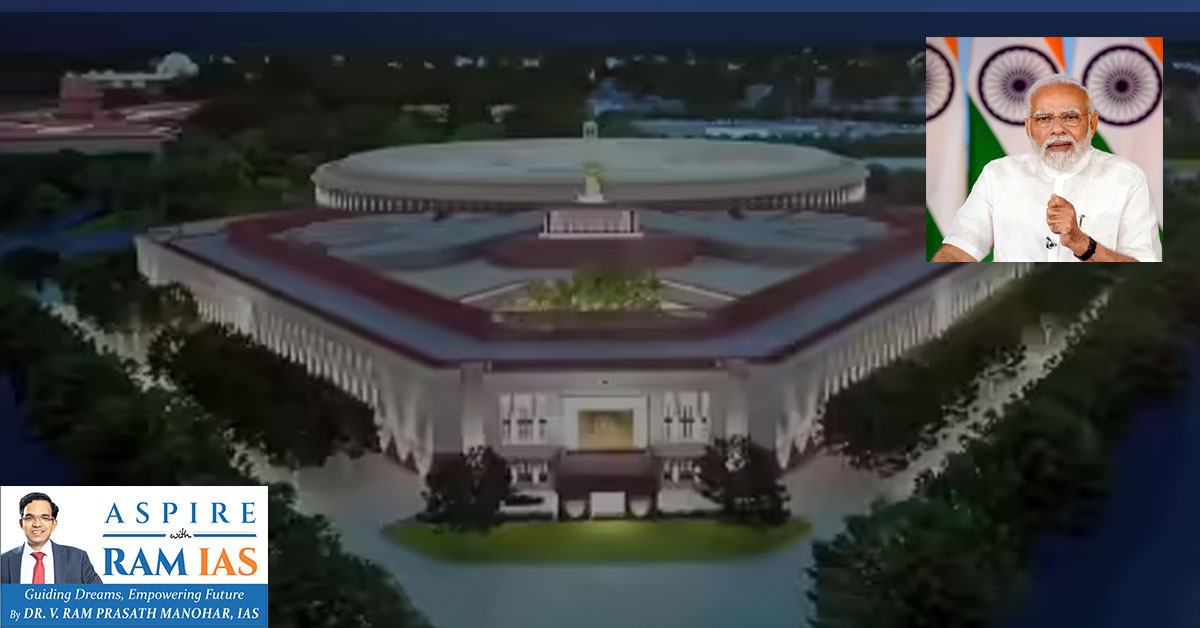
Why is India called a ‘Prime Ministerial Government’?
India is described as a Prime Ministerial Government because real executive authority is concentrated in the Prime Minister, while the President functions as the nominal head. The Prime Minister leads the Council of Ministers, controls policy direction, and dominates decision-making in the parliamentary system.
Position and Status
- The Prime Minister (PM) is the head of government.
- He/She is the de facto executive authority, while the President is the de jure head.
- Leader of the majority party or coalition in the Lok Sabha.
- Central figure in policy formulation, administration, and governance.
Constitutional Provisions Related to the Prime Minister
Article | Provision |
Article 74(1) | There shall be a Council of Ministers with the Prime Minister at the head to aid and advise the President |
Article 75(1) | The Prime Minister is appointed by the President |
Article 75(2) | Ministers hold office during the pleasure of the President |
Article 75(3) | The Council of Ministers is collectively responsible to the Lok Sabha |
Article 75(4) | Ministers must take an oath before entering office |
Article 84 | Eligibility to be a Member of Parliament |
Appointment of the Prime Minister
- Appointed by the President under Article 75.
- Conventionally, the leader of the majority party in the Lok Sabha is appointed.
- If no clear majority:
- The President may use discretion.
- The leader of the largest party/coalition is invited.
- Must prove a majority on the floor of the House within a reasonable time.
Oath, Term, and Salary
Oath
Administered by the President. The PM swears to:
- Uphold the Constitution
- Maintain the sovereignty and integrity of India
- Perform duties without fear or favour
Term
- No fixed term
- Continues as long as he/she enjoys the majority support in the Lok Sabha
- Loss of confidence → resignation or dismissal
Salary
- Determined by Parliament
Same salary as a Member of Parliament + allowances and official perks
Powers of the Prime Minister
1. Executive Powers
- Head of the Union Council of Ministers
- Chairs Cabinet meetings
- Coordinates the work of all ministries
- Controls policy execution
2. Legislative Powers
- Member of either House of Parliament
- Advises the President on:
- Summoning Parliament
- Prorogation
- Dissolution of Lok Sabha
- Announces government policies in Parliament
3. Appointment Powers
Advises the President on appointments of:
- Ministers
- Governors
- Chief Justice and Judges
- Chief Election Commissioner
- Comptroller and Auditor General
- Attorney General
4. Diplomatic Powers
- Represents India internationally
- Shapes foreign policy
- Negotiates treaties and agreements
5. Emergency Powers
- Advises the President during National, State, and Financial Emergencies
- Key political decision-maker in crises
6. Financial Powers
- Overall control over economic policy
- The government presents the Union Budget under the PM’s leadership
Functions and Responsibilities
A. Relation with Council of Ministers
- Selects ministers
- Allocates portfolios
- Can seek the resignation of ministers
- Guides and controls the functioning of ministries
- Resignation of the PM leads to the collapse of the entire Council
B. Relation with the President
- Principal channel of communication
- Informs the President about:
- Cabinet decisions
- Legislative proposals
- Advises on key constitutional appointments
C. Relation with Parliament
- Leader of Lok Sabha
- Recommends dissolution of the Lok Sabha
- Leads government business
- Defends policies on the floor of the House
Other Important Roles
- Chairman of:
- NITI Aayog
- Inter-State Council
- National Integration Council
- National Water Resources Council
- Chief spokesperson of the Government
- Political head of the civil services
- Leader of the ruling party
Prime Minister’s Office (PMO)
Role
- Administrative support body to the Prime Minister
- Assists in:
- Policy coordination
- Decision-making
- Monitoring implementation
Head
- Principal Secretary to the Prime Minister
Bodies under PMO
- Department of Atomic Energy
- Department of Space
- National Security Council Secretariat
Note
- PM is not elected directly
- PM can be from Lok Sabha or Rajya Sabha
- Collective responsibility → real power lies with the PM
- The President cannot remove the PM arbitrarily
- PM’s resignation leads to the fall of the Council of Ministers
MCQs
Q1. With reference to the Prime Minister of India, consider the following statements:
1. The Prime Minister is appointed by the President.
2. The Prime Minister must necessarily be a member of the Lok Sabha.
3. The Prime Minister holds office during the pleasure of the President.
Which of the statements given above are correct?
A. 1 and 2 only
B. 1 and 3 only
C. 2 and 3 only
D. 1, 2, and 3
Answer: B
Q2. Which one of the following best explains why the Indian system of government is often described as a “Prime Ministerial Government”?
A. The Prime Minister is directly elected by the people
B. The Prime Minister combines legislative and executive powers
C. Real executive authority is concentrated in the office of the Prime Minister
D. The Prime Minister is both Head of State and Head of Government
Answer: C
Q3. The Prime Minister of India can be removed from office when:
A. The President withdraws pleasure
B. A resolution of impeachment is passed by Parliament
C. The Prime Minister loses the confidence of the Lok Sabha
D. The Rajya Sabha passes a no-confidence motion
Answer: C
