
Study Materials
General Studies - Polity
Council of Ministers (CoM)
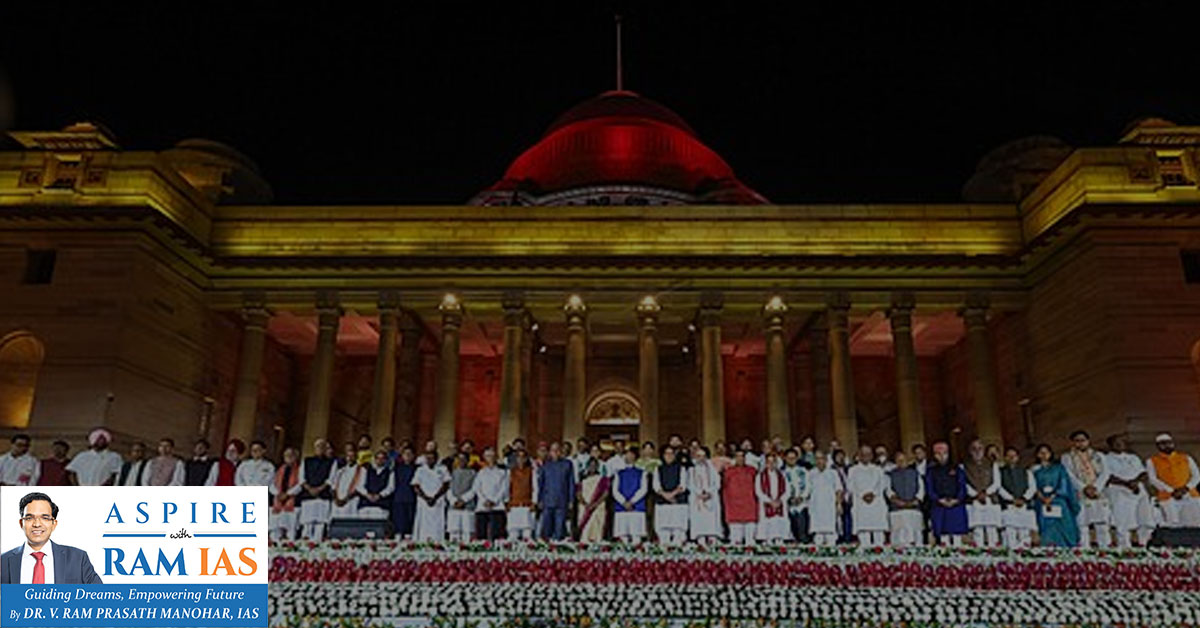
What is the Council of Ministers?
- The Council of Ministers is the highest executive decision-making body of the Union Government.
- It is headed by the Prime Minister and functions to aid and advise the President (Article 74).
Strength of the Council of Ministers
- As per the 91st Constitutional Amendment Act, 2003:
- The total number of ministers shall not exceed 15% of the total strength of the Lok Sabha.
Composition of the Council of Ministers
The CoM consists of the following categories:
- Cabinet Ministers
- Head major ministries (Home, Defence, Finance, External Affairs, etc.)
- Form the Cabinet, the real decision-making body
- Ministers of State (Independent Charge)
- Head smaller ministries independently
- Do not attend Cabinet meetings unless invited
- Ministers of State
- Assist Cabinet Ministers
- Deputy Ministers
- Assist Ministers in administrative and parliamentary work
(Rarely appointed now)
- Assist Ministers in administrative and parliamentary work
Note: The post of Deputy Prime Minister is not constitutional, but political.
Key Constitutional Provisions Related to CoM
Article 74
- Council of Ministers, with the PM at the head, to aid and advise the President
- Advice is binding and cannot be questioned in court
Article 75
- PM appointed by the President; other ministers on the PM’s advice
- Ministers hold office during the pleasure of the President
- Collective responsibility to the Lok Sabha
- The Minister must be an MP within 6 months
- Oath administered by the President (Third Schedule)
Article 77
- Executive actions taken in the name of the President
- The President makes rules for the allocation of business
Article 78
- PM’s duty to:
- Communicate decisions to the President
- Furnish the information sought by the President
Article 88
- Ministers have the right to speak in both Houses of Parliament (even if not a member)
Oath and Salary of Ministers
- Oath: Administered by the President (Third Schedule)
- Salary & allowances:
- Determined by Parliament
- Specified in the Second Schedule
Responsibilities of the Council of Ministers
Collective Responsibility
- Enshrined in Article 75
- CoM is collectively responsible to the Lok Sabha
- Defeat in a No-Confidence Motion → entire CoM resigns
Individual Responsibility
- Ministers serve at the pleasure of the President
- Removal is done on the advice of the Prime Minister
Significance of CoM in Parliamentary Democracy
- Policy formulation
- Policy implementation
- Leadership of the executive
- Accountability to Parliament
- Must maintain the confidence of the Lok Sabha
Council of Ministers vs Cabinet
Council of Ministers | Cabinet |
Includes all ministers | Includes only Cabinet Ministers |
Large body (≤15% of Lok Sabha) | Small, powerful body |
Constitutional body | Inner core of CoM |
Powers exist in theory | Exercises real executive power |
Decisions are not directly binding | Decisions are binding on all ministers |
MCQs
Q1. The maximum strength of the Union Council of Ministers cannot exceed 15% of the total strength of the Lok Sabha, as per which Constitutional Amendment?
A. 42nd Constitutional Amendment Act
B. 44th Constitutional Amendment Act
C. 91st Constitutional Amendment Act
D. 97th Constitutional Amendment Act
Answer: C
Q2. Which Article of the Indian Constitution provides for the principle of collective responsibility of the Council of Ministers?
A. Article 74
B. Article 75
C. Article 77
D. Article 88
Answer: B
Q3. Which of the following ministers are members of the Cabinet?
A. All Ministers of State
B. Only Cabinet Ministers
C. Cabinet Ministers and Ministers of State
D. Cabinet Ministers and Deputy Ministers
Answer: B
Q4. A person who is not a member of either House of Parliament can remain a Union Minister for a maximum period of:
A. 3 months
B. 6 months
C. 12 months
D. Entire term of the Lok Sabha
Answer: B
Q5. The advice tendered by the Council of Ministers to the President:
A. Can be rejected by the President
B. Can be reviewed by the Supreme Court
C. Is binding and cannot be inquired into by courts
D. Is binding only in emergency situations
Answer: C
