
Study Materials
General Studies - Geography
Nuclear Disc Model (Neo-Laplacian Model)
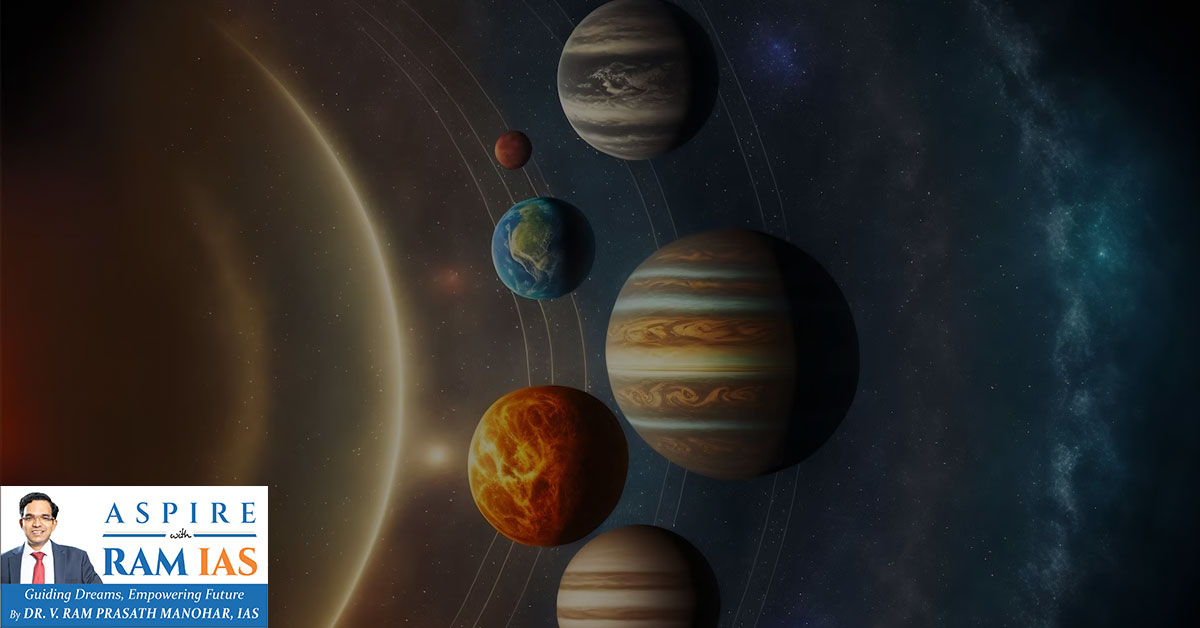
Core Idea
- The solar system formed from a rotating interstellar nebula (gas + dust).
- Explains Sun and planets formation together, unlike earlier encounter theories.
Timeline
- Nebula collapse began: ~5–5.6 billion years ago
- Formation of Sun & planets: ~4.6 billion years ago
- Age of Earth: ~4.54 billion years
Formation of the Sun
- Nebula became gravitationally unstable (possibly due to a nearby supernova shock).
- Gravitational collapse led to a dense, hot central core.
- ~99.9% of matter accumulated at centre → Protosun.
- Nuclear fusion started → Sun formed.
- Remaining ~0.1% matter formed a rotating protoplanetary disc.
Protoplanetary Disc
- Flat, rotating disc of gas and dust around the Sun.
- Site for planet formation.
Formation of the Planets
- Dust particles collided → accretion.
- Formation sequence:
- Dust grains
- Planetesimals (a few km-sized bodies)
- Protoplanets
- Planets
Planet Types (Temperature-based differentiation)
Inner Solar System (Hot Region)
- Composition: Silicates & metals
- Planets: Mercury, Venus, Earth, Mars
- Type: Terrestrial (rocky) planets
- Metal-rich cores (Iron, Nickel)
Outer Solar System (Cool Region)
- Composition: Ice, hydrogen, helium
- Planets: Jupiter, Saturn, Uranus, Neptune
- Type: Gas & ice giants
Asteroids
- Leftover rocky material not accreted.
- Concentrated mainly in the Asteroid Belt (Mars–Jupiter).
Iron Catastrophe
- Occurred ~4.5 billion years ago.
- Earth heated beyond the iron melting point (~1538°C).
- Triggered a large-scale internal rearrangement.
Planetary Differentiation
- Heavy metals (iron, nickel) sank to form the core.
- Lighter materials (silicates, water, gases) rose upward.
- Led to the formation of:
- Core
- Mantle
- Crust
MCQs
Q1. According to the Nuclear Disc Model, what percentage of the original nebular material formed the Sun?
A. About 50%
B. About 75%
C. About 90%
D. About 99.9%
Answer: D
Q2. The flat, rotating structure from which planets formed in the early solar system is known as the:
- Solar wind belt
B. Asteroid halo
C. Protoplanetary disc
D. Kuiper disc
Answer: C
Q3. Planetesimals in the inner solar system were primarily composed of:
A. Ice and hydrogen
B. Water ice and methane
C. Silicates and metals
D. Helium and ammonia
Answer: C
