
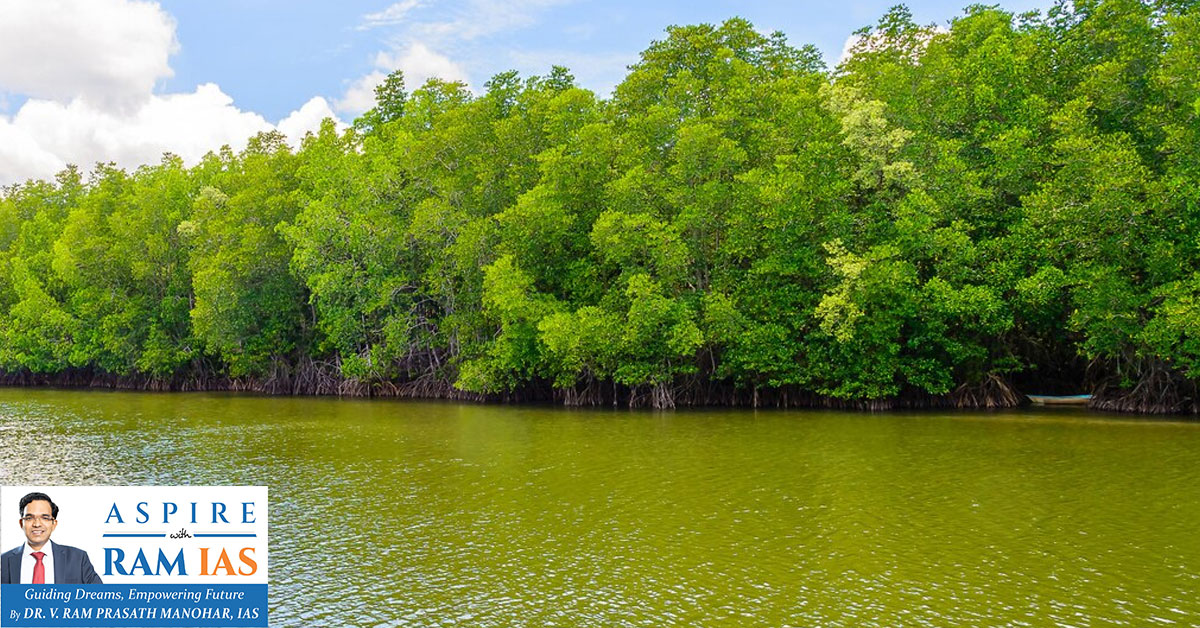
1. Aquatic Ecosystems
Aquatic ecosystems are ecosystems where plants and animals live in water.
Classification of Aquatic Ecosystems
- Freshwater ecosystems
- Very low salt content (< 5 ppt)
- Examples:
- Lentic (still water): lakes, ponds, swamps
- Lotic (running water): rivers, streams
- Marine ecosystems
- High salt content (≈ 35 ppt or more)
- Examples: oceans, seas
- Brackish water ecosystems
- Salt content between 5–35 ppt
- Examples: estuaries, mangroves, salt marshes
Estuaries and mangroves belong to brackish water ecosystems.
2. Estuarine Ecosystem
What is an Estuary?
An estuary is a partially enclosed coastal area where:
- Freshwater from rivers
- mixes with
- Saline seawater
Examples:
- River mouths
- Coastal bays
- Lagoons
- Deltas
Key Features of Estuaries
- Salinity keeps changing (0–35 ppt)
- Strongly influenced by tides
- Acts as a transition zone (ecotone) between land and sea
- Organisms show osmoregulation (adaptation to changing salinity)
- Very nutrient-rich
Formation of Estuaries
Estuaries are formed due to:
- Rise in sea level
- Tectonic activity
- Glacial processes
- Sand and sandbar movement
Importance of Estuaries
Estuaries are among the most productive ecosystems in the world. Why?
- Mixing of freshwater and seawater brings nutrients
- Supports species from both marine and freshwater ecosystems
Major Importance
- Highly productive fishing grounds
- Act as natural pollution filters
- Trap sediments → help in delta formation
- Mangroves near estuaries protect coasts from cyclones
- Buffer between land and sea
- Ideal locations for ports and harbours
- Support livelihoods of coastal populations
About 60% of the world’s population lives near coasts and estuaries.
3. Lagoon vs Estuary
| Feature | Estuary | Lagoon |
| Freshwater input | Present | Mostly absent |
| Water movement | Strong | Sluggish |
| Salinity | Moderate | Higher |
| Depth | Deeper | Shallow |
| Formation | Sea-level rise | Sea-level fall |
| Indian example | Konkan coast | Kerala backwaters |
4. Estuarine Vegetation & Life
- Vegetation depends on salinity & flooding
- Includes:
- Mangroves
- Salt marshes
- Seagrasses
- Mudflats
- Highly dynamic ecosystem
Common organisms:
- Phytoplankton (diatoms, algae)
- Fish, prawns, crabs
- Birds like pelicans
- Sea turtles, sea catfish
5. Estuarine Ecosystem in India
- India has 14 major, 44 medium, and 162 minor rivers
- Most major estuaries are on the East Coast
- West coast estuaries are smaller but deeper
Examples:
- East coast: Hooghly, Godavari, Krishna
- West coast: Mandovi, Zuari
Issues in Indian Estuaries
- Industrial & sewage pollution
- Overfishing
- Aquaculture expansion
- Dredging & navigation
- Blocking fish migration routes
- Habitat destruction (Chilika, Pulicat)
6. Mangroves
What are Mangroves?
Mangroves are:
- Salt-tolerant (halophyte) trees and shrubs
- Found in coastal brackish water areas
- Grow in intertidal zones (between land and sea)
- Best example of an ecotone ecosystem
Key Characteristics of Mangroves
- Evergreen forests
- Grow in muddy, oxygen-poor soils
- Highly productive ecosystems
- Protect coastlines from:
- Cyclones
- Tsunamis
- Coastal erosion
Adaptations of Mangroves (Very Important)
- Salt tolerance
- Salt-secreting glands
- Salt exclusion at roots
- Special roots
- Prop roots (Rhizophora)
- Pneumatophores (Avicennia) – for breathing
- Stilt roots
- Vivipary
- Seeds germinate on the tree itself
- Helps survival in saline water
- Low oxygen adaptation
- Roots adapted to anaerobic muddy soil
7. Mangroves in India
Distribution
- India has ~3% of the world’s mangroves
- Mostly along:
- East coast
- Andaman & Nicobar Islands
- Gujarat coast
Major Mangrove Regions in India
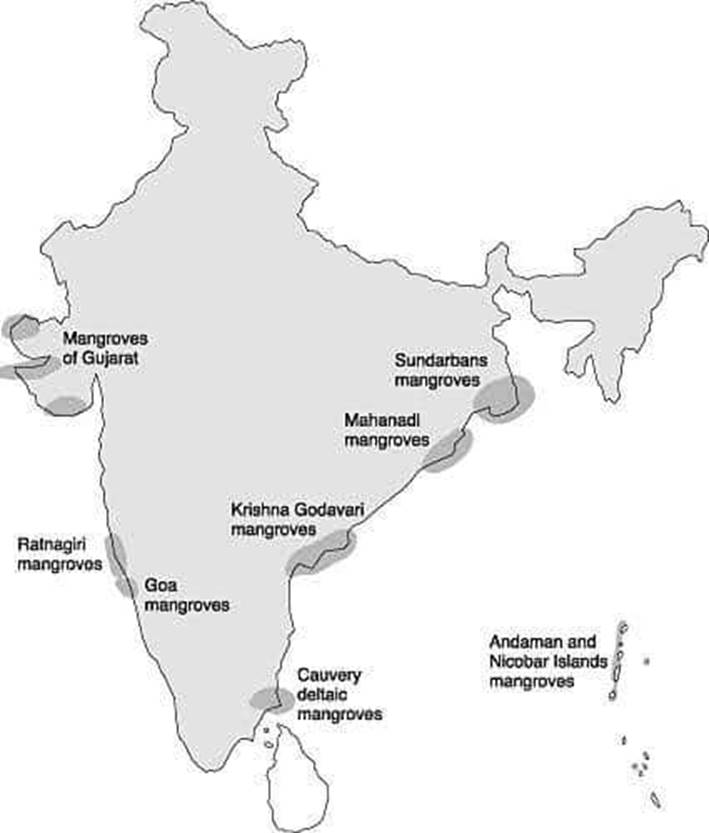
1. Sundarbans (West Bengal)
- The largest mangrove forest in the world
- Home to the Royal Bengal Tiger
- Formed by Ganga–Brahmaputra delta
2. Bhitarkanika (Odisha)
- Second largest mangrove forest in India
- High biodiversity
3. Godavari–Krishna Delta (Andhra Pradesh)
- Dense mangrove swamps
4. Pichavaram & Vedaranyam (Tamil Nadu)
- Degraded due to aquaculture & salt pans
5. Gujarat (Gulf of Kutch)
- Dominant species: Avicennia
- Scrubby and dwarf mangroves
- Improving condition (Kori Creek)
6. Andaman & Nicobar Islands
- Dense, diverse, undisturbed mangroves
8. Importance of Mangroves
Ecological Importance
- Prevent coastal erosion
- Reduce the impact of cyclones & tsunamis
- Act as carbon sinks
- Support marine biodiversity
Economic & Social Importance
- Fish breeding & nursery grounds
- Livelihoods for coastal communities
- Source of timber, fuelwood, and medicines
9. Threats to Mangroves
- Conversion to agriculture & aquaculture
- Urbanisation & industrialisation
- Oil spills
- Pollution
- Climate change & sea-level rise
