
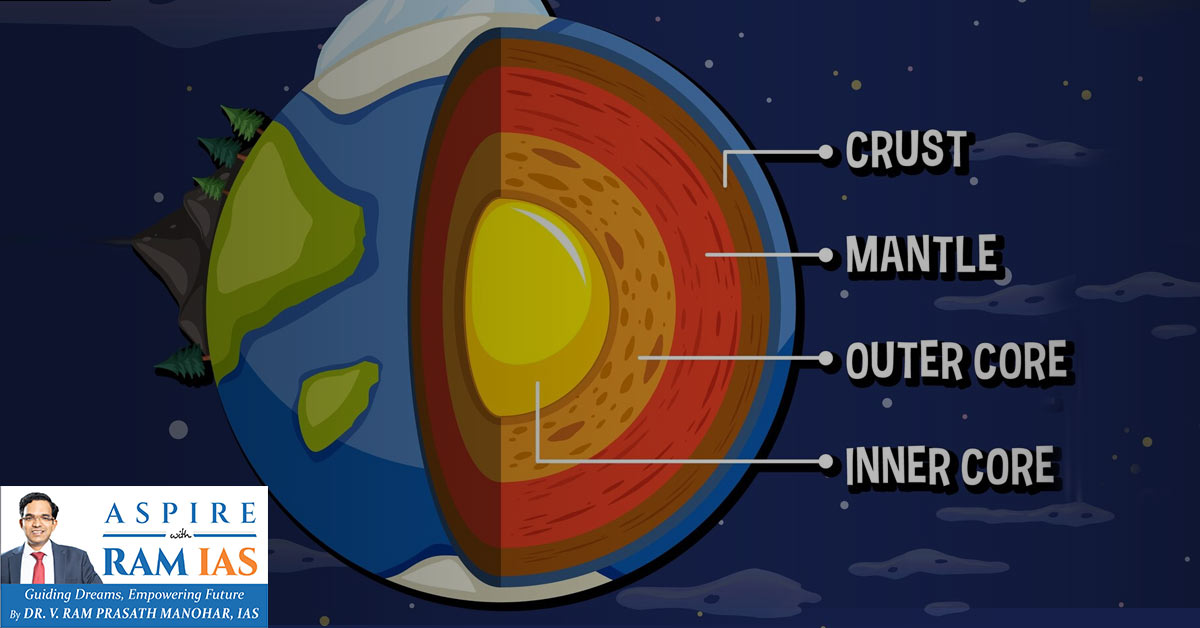
The Earth is composed of concentric layers with distinct physical and chemical properties. These layers are studied using seismic waves generated during earthquakes.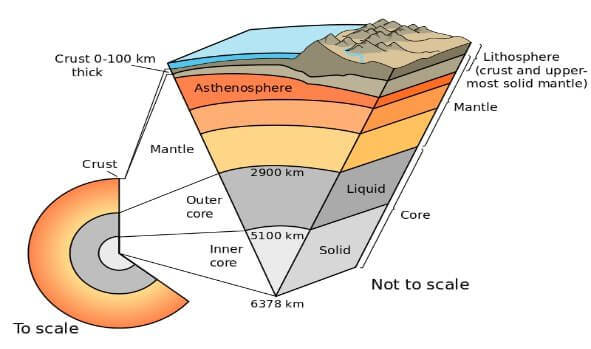
Broad Classification
Mechanical basis
- Lithosphere
- Asthenosphere
- Mesospheric mantle
- Outer core
- Inner core
Chemical basis
- Crust
- Upper mantle
- Lower mantle
- Outer core
- Inner core
The Crust
- Outermost solid layer of the Earth
- Accounts for 5–1% of Earth’s volume and less than 1% of its mass
- Average density: ~2.7 g/cm³
- Thickness:
- Oceanic crust: 5–30 km
- Continental crust: 30–70 km
- Mountain regions (Himalayas): 70–100 km
Composition
- Upper crust: sedimentary rocks over crystalline igneous and metamorphic rocks
- Lower crust: basaltic and ultrabasic rocks
- Continental crust: felsic rocks (rich in silica, aluminium, sodium, potassium) – granite
- Oceanic crust: mafic rocks (rich in iron and magnesium) – basalt
Temperature
- Increases with depth
- About 200–400°C at the crust–mantle boundary
- Average geothermal gradient: ~30°C per km in upper crust
Most Abundant Elements in Earth’s Crust
- Oxygen
- Silicon
- Aluminium
- Iron
- Calcium
- Sodium
- Potassium
- Magnesium
Mnemonic: OS CIA Na K Mg
Mohorovicc Discontinuity (Moho)
- The boundary between the crust and the mantle
- Identified by a sudden increase in seismic wave velocity
- Depth:
- Under oceans: ~8 km
- Under continents: ~30 km
- Caused by a change in rock composition from feldspar-rich rocks to feldspar-free rocks
Lithosphere
- Rigid outer layer of Earth
- Includes crust + uppermost mantle
- Thickness: 10–200 km
- Broken into tectonic plates
- Plate movements cause:
- Earthquakes
- Volcanism
- Folding and faulting
- Heat source for plate movement:
- Primordial heat
- Radioactive decay of uranium, thorium, and potassium
Mantle
- Extends from Moho to 2900 km depth
- Accounts for:
- 83% of Earth’s volume
- 67% of Earth’s mass
- Composition: silicate rocks rich in iron and magnesium
Upper Mantle
- Density: 9–3.3 g/cm³
- Includes asthenosphere
Lower Mantle
- Solid state
- Density: 3–5.7 g/cm³
Temperature
- From ~200°C near crust to ~4000°C near core
- Heat causes mantle convection, driving plate tectonics
Seismicity
- Earthquakes observed up to 670 km depth in subduction zones
Asthenosphere
- Weak, ductile layer of the upper mantle
- Lies below the lithosphere
- Depth: ~80–200 km
- Highly viscous and partially molten
- Functions:
- Facilitates plate movement
- Source of magma
- Enables isostatic adjustment
Outer Core
- Lies between 2900 km and 5100 km
- Composition: iron + nickel (NiFe) with lighter elements
- State: liquid
- Density: 9–12.2 g/cm³
- Temperature: 4400–6000°C
Importance
- Convection currents + Coriolis force generate Earth’s magnetic field
- Explained by Dynamo Theory
Inner Core
- Extends from 5100 km to Earth’s centre
- Composition: ~80% iron, some nickel
- State: solid due to immense pressure
- Density: 6–13 g/cm³
- Temperature: ~6000°C
- Can transmit S-waves, unlike the outer core
- Rotates slightly faster than Earth’s surface
- Does not hold a permanent magnetic field
Core Contribution
- Volume: ~16% of Earth
- Mass: ~33% of Earth
Seismic Discontinuities
Seismic discontinuities are zones where seismic wave velocity changes abruptly due to a change in composition or state.
Major Discontinuities
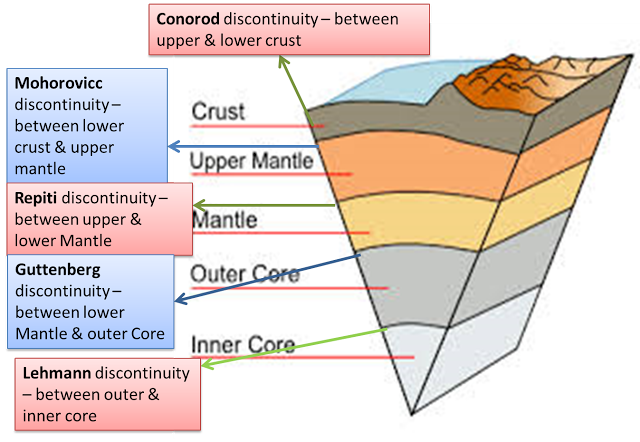
- Mohorovicc Discontinuity – crust–mantle boundary
- Gutenberg Discontinuity – mantle–outer core boundary
- Lehmann Discontinuity – outer core–inner core boundary
Pointers
- S-waves cannot travel through liquids
- The outer core is responsible for the magnetic field
- Continental crust is thicker but lighter than oceanic crust
- Mantle convection drives plate tectonics
- An increase in pressure generally increases the melting point, except for ice
