
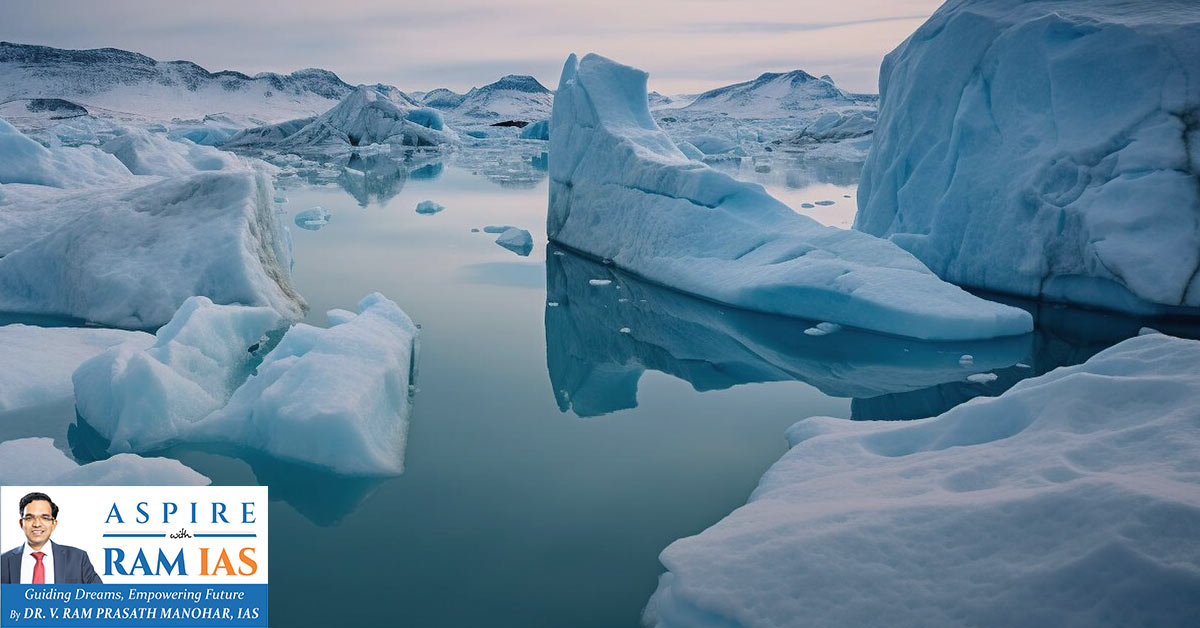
 Glacier
- Glacier = moving mass of ice (a few meters/day)
- Acts as an agent of erosion, transportation & deposition
- Carries rock debris → strong abrasive power
Types of Glaciers
1. Continental Glaciers
- Large ice sheets
- Found in:
- Antarctica
- Greenland
2. Ice Caps
- Cover mountain tops
- Feed valley glaciers
3. Piedmont Glaciers
- Form a continuous sheet at the mountain base
- Example: Southern Alaska
4. Valley (Alpine) Glaciers
- Found in high mountain ranges
- In India:
- Siachen Glacier (≈72 km)
- Gangotri Glacier (≈25 km)
Glacial Erosional Landforms
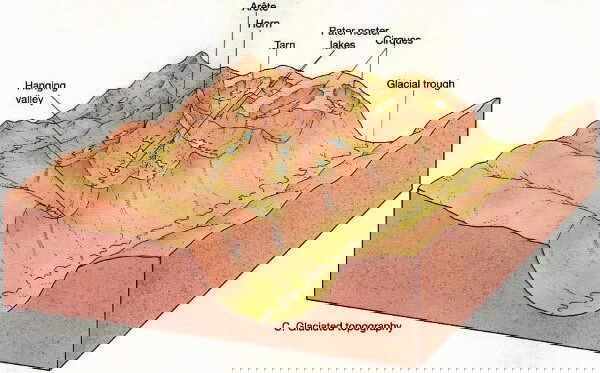
1. Cirque / Corrie
- A bowl-shaped hollow on mountain side
- Steep on 3 sides, open on 1 side
- Flat bottom
- May form Tarn Lake after melting
2. Glacial Trough (U-shaped Valley)
- Modified river valley
- Broad floor + steep sides
- Uniform vertical & lateral erosion
- Mature stage valley
3. Hanging Valley
- The smaller tributary valley remains at a higher level
- Joins the deeper main valley
- Often forms waterfalls
4. Arete
- Narrow sharp ridge
- Formed between two cirques
5. Horn
- Pyramidal peak
- Formed when 3+ cirques erode a summit
- Example: Matterhorn (Switzerland)
6. Fjord
- A drowned U-shaped valley at the coast
- Deep, narrow, steep-sided
- Found in:
- Norway
- New Zealand
- Greenland
Glacial Depositional Landforms
1. Outwash Plain (Till Plain)
- Stratified sediments
- Sand, gravel, clay
- Formed at the glacier’s melting front
2. Moraine
- Accumulation of debris
- Types:
- Ground moraine
- Lateral moraine
- Terminal (End) moraine
- Medial moraine
3. Esker
- Long winding ridge
- Deposited by sub-glacial streams
- Often used for roads
4. Drumlin
- Inverted boat-shaped hill
- Indicates glacier movement direction
5. Kame Terraces
- Irregular mound-like deposits
- Form along glacier sides
6. Kettle Holes
- Depressions in the outwash plain
- Formed due to the melting of buried ice blocks
- May become kettle lakes
Glacial Cycle of Erosion
Youth
- Cirque formation
- Initial valley cutting
- Aretes & horns developing
Maturity
- Hanging valleys visible
- The glacial trough is well developed
- Stepped valley profile
Old Age
- Fully developed U-shaped valley
- Prominent depositional features
- Outwash plain formation
Rapid Revision Table
|
Erosional |
Depositional |
|
Cirque |
Moraine |
|
Arete |
Esker |
|
Horn |
Drumlin |
|
U-shaped valley |
Kame |
|
Hanging valley |
Kettle hole |
|
Fjord |
Outwash plain |
