
Meaning of Karst Topography
Karst topography is a landscape formed by the dissolution of soluble rocks such as:
- Limestone
- Dolomite
- Gypsum
It is characterised by:
- Underground drainage systems
- Sinkholes
- Caves and caverns
The dissolution occurs when rainwater mixed with carbon dioxide forms carbonic acid, which dissolves limestone.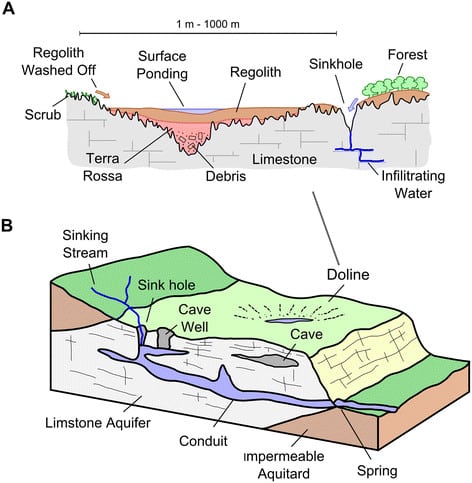
Rocks Associated with Karst
Limestone
- Sedimentary rock is mainly composed of Calcium Carbonate (CaCO₃).
- Formed from corals, shells, and marine organisms.
Chalk
- Soft and pure form of limestone.
- Highly porous, hence karst is less developed.
Conditions for Karst Formation
Karst landscapes develop best when:
- Limestone rocks are dense and fractured
- Rainfall is moderate to heavy
- Water table is low
- Rocks contain many joints and fissures
These conditions allow groundwater circulation and chemical dissolution.
Distribution of Karst
World Examples
- Causses (France)
- Kwangsi (China)
- Yucatán Peninsula (Mexico)
- Kentucky and Florida (USA)
Karst Regions in India
- Vindhya region
- Dehradun and Eastern Himalayas
- Pachmarhi (Madhya Pradesh)
- Borra Caves (Andhra Pradesh)
- Bastar (Chhattisgarh)
- Gupt Godavari caves (Uttar Pradesh)
Characteristics of Karst Topography
- Absence of surface drainage
- Development of underground drainage systems
- Presence of sinkholes and caves
- Formation of limestone pavements
- Presence of dry valleys
Erosional Landforms of Karst
1. Limestone Pavement
- Flat limestone surface with cracks.
- Consists of:
Clints → Limestone blocks
Grikes → Deep cracks between blocks.
2. Sinkholes / Swallow Holes / Dolines
- Circular depressions formed by the dissolution or collapse of limestone.
Local names:
- Cenotes – Mexico
- Blue holes – Underwater sinkholes
- Sotanos – Mexico
3. Blind Valley
- A valley that ends abruptly where a stream disappears underground.
4. Lapies / Karren
- Small grooves, ridges, and pits formed by the solution of limestone.
5. Pinnacles
- Sharp vertical limestone projections formed due to dissolution.
6. Karst Window (Fenster)
- Occurs when the roof of an underground cave collapses, exposing the underground stream.
7. Uvala
- A large depression formed by the merging of several sinkholes (dolines).
8. Polje
- Large flat-floored depression in karst areas.
- Size: 5–400 km².
9. Caves and Caverns
- Underground cavities formed by the dissolution of limestone by groundwater.
Example:
- Borra Caves (Andhra Pradesh)
Depositional Landforms of Karst
Deposits inside caves are collectively called Speleothems.
1. Stalactites
- Icicle-shaped deposits hanging from cave roofs.
- Formed by the precipitation of calcium carbonate.
2. Stalagmites
- Upward-growing deposits on cave floors.
- Formed from dripping water containing minerals.
3. Pillars (Columns)
- Formed when stalactites and stalagmites join together.
4. Drapes / Curtains
- Thin sheet-like calcite deposits hanging from cave ceilings.
5. Tufa
- A porous limestone deposit formed by precipitation of calcium carbonate from water.
6. Travertine
- A harder and more compact form of tufa formed near springs and rivers.
Karst Lakes
- Formed due to the collapse of underground caves.
- Often, temporary lakes appear after heavy rainfall.
Soil in Karst Regions
Terra Rossa
- Reddish clayey soil formed over limestone.
- Well-drained and rich in iron oxide.
Economic Importance of Karst
- Limestone mining
- Cement industry
- Building material
- Tourism (caves)
However:
- Agriculture is limited due to thin soil cover and poor drainage.
