
Study Materials
General Studies - Modern History
Anglo-Mysore Wars (1767–1799)
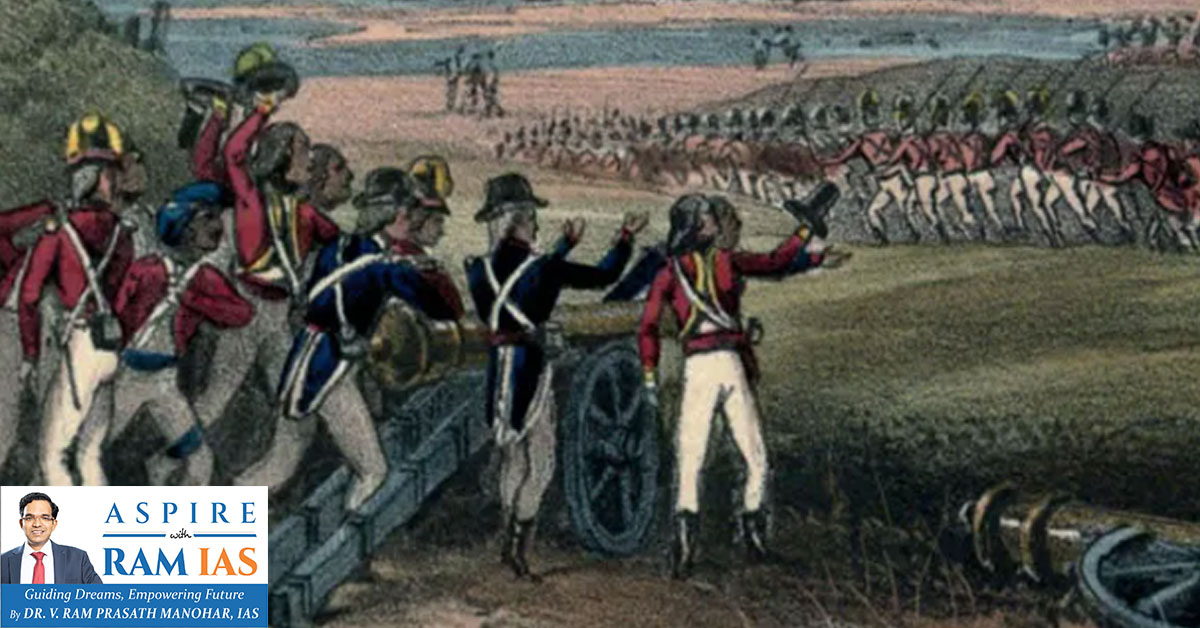
Anglo-Mysore Wars (1767–1799)
Struggle between the Kingdom of Mysore and the British East India Company for control over South India.
Mysore Before the British
- After the Battle of Talikota (1565), the Vijayanagara Empire collapsed.
- The Wodeyar dynasty ruled Mysore as nominal rulers.
- Haidar Ali became the de facto ruler in 1761 by sidelining the Wodeyars.
Haidar Ali – Foundation of Mysore’s Power
- Strengthened the army on European lines with French help.
- Set up an arms factory at Dindigul (Tamil Nadu).
- Introduced Western military training.
- Expanded Mysore by capturing Dod Ballapur, Sera, Bednur, and Hoskote (1761–63).
- Subdued Poligars of South India.
- Fought Marathas repeatedly (1774–76).
Haidar Ali transformed Mysore into a strong military state capable of challenging the British.
First Anglo-Mysore War (1767–1769)
Cause
- British expansion in South India threatened Mysore.
Strategy of Haidar Ali
- Used diplomacy:
- Made Marathas neutral
- Allied with the Nizam of Hyderabad
Outcome
- Haidar Ali advanced up to Madras.
- The British forced the Indians to sign the Treaty of Madras (1769).
Treaty of Madras
- Restored territories to both sides.
- The British agreed to help Mysore if attacked.
Seen as a diplomatic success for Haidar Ali.
Second Anglo-Mysore War (1780–1784)
Causes
- Haidar Ali’s alliance with the French
- British attack on Mahe, a French settlement under Mysore protection.
Major Events
- Alliance of Mysore + Marathas + Nizam against the British.
- Haidar Ali:
- Captured Arcot
- Defeated the British at the Battle of Pollilur (1781) (Colonel Baillie).
- British commander Sir Eyre Coote later defeated Haidar at Porto Novo (1781).
- Haidar Ali still managed to defeat the British commander Braithwaite
Treaty of Mangalore (1784)
- Signed after the death of Haidar Ali (1782).
- Tipu Sultan continued the war.
- Result:
- Status quo restored.
- Territories returned to both sides.
Last treaty where Indians dictated terms to the British.
Third Anglo-Mysore War (1790–1792)
Cause
- Tipu Sultan attacked Travancore, a British ally.
British Strategy
- Alliance with:
- Marathas
- Nizam of Hyderabad
Outcome
- The British captured Seringapatam.
Treaty of Seringapatam (1792)
- Tipu lost half of Mysore’s territory:
- British: Malabar, Dindigul, Baramahal
- Marathas: areas near Tungabhadra
- Nizam: areas between Krishna and Pennar
- War indemnity: ₹3 crore
- Two sons of Tipu were taken as hostages
Major blow to Mysore’s sovereignty.
Fourth Anglo-Mysore War (1799)
Causes
- Tipu’s desire to avenge humiliation
- Fear of Tipu–French alliance
- Aggressive policy of Lord Wellesley (Subsidiary Alliance)
Events
- War: 17 April – 4 May 1799
- British generals: Harris, Stuart
- Arthur Wellesley also participated.
- The British were supported by Marathas and the Nizam.
Outcome
- Fall of Seringapatam
- Death of Tipu Sultan (1799)
End of Mysore as an independent power.
Mysore After Tipu
- The Wodeyar dynasty was restored under minor Krishnaraja III.
- Mysore accepted Subsidiary Alliance → British control.
- 1831: The British took direct control, citing misgovernance.
- 1881: Kingdom restored by Lord Ripon.
Tipu Sultan
- Known as “Tiger of Mysore”
- Army trained on the European model
- Pioneer of rocket technology (used iron-cased rockets).
- Introduced sericulture in Mysore.
- Established Board of Admiralty (1796).
- Planned Navy:
- 22 battleships
- 20 large frigates
- Dockyards at:
- Mangalore
- Wajedabad
- Molidabad
- Allowed Jacobin Club; called himself “Citizen Tipu”.
Why Anglo-Mysore Wars Matter
- Show Indian resistance to colonial expansion
- Highlight the early use of modern warfare
- Explain the British strategy of alliances
- Marks rise of the Subsidiary Alliance system
- Turning point in British dominance in South India
