
Study Materials
General Studies - Modern History
Battle of Plassey (1757)
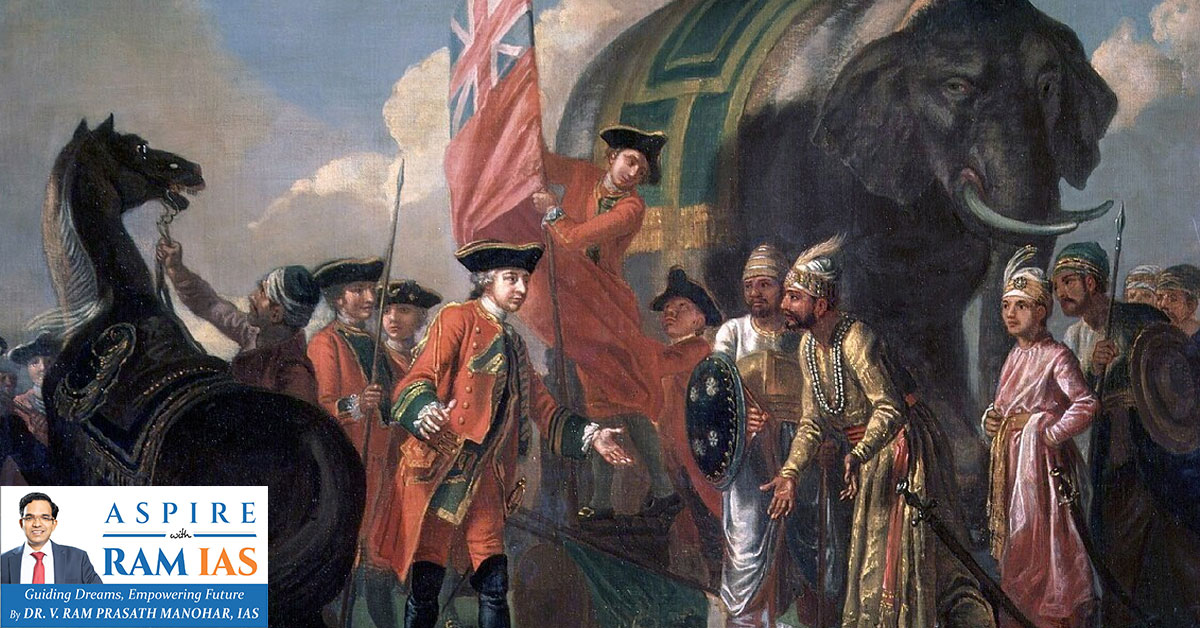
Basic Facts
- Year: 23 June 1757
- Place: Plassey (Palashi), Bengal (on the banks of the River Bhagirathi)
- Between:
- British East India Company → Robert Clive
- Nawab of Bengal → Siraj-ud-Daulah
- Result: Decisive victory of the British East India Company
Bengal on the Eve of Plassey
- Bengal was the richest province of Mughal India.
- Major trade hub → nearly 60% of British imports from Asia came from Bengal.
- Prosperous cities: Murshidabad, Calcutta, Dacca
- Stable rule under Murshid Quli Khan, Shujauddin, Alivardi Khan
- English resentment due to:
- Misuse of trade privileges
- Loss of revenue to the Nawab’s treasury
Causes of the Battle of Plassey
Economic Causes
- Misuse of dastaks (duty-free trade permits) by Company officials
- Massive loss to Bengal’s exchequer
Political Causes
- Fortification of Fort William (Calcutta) without the Nawab’s permission
- Granting asylum to Krishna Das, a political fugitive
French Factor
- The British feared Siraj-ud-Daulah’s possible alliance with the French
Internal Conspiracy
- Discontented nobles: Mir Jafar, Jagat Seth, Rai Durlabh, Omichand
- Secret pact between Robert Clive and Mir Jafar
Immediate Cause
- Capture of Calcutta by Siraj-ud-Daulah
- Black Hole of Calcutta (1756) episode (controversial but cited)
Course of the Battle
- Robert Clive arrived from Madras with reinforcements
- Secret agreement:
- Mir Jafar to be Nawab
- The company is to receive rewards
- Siraj’s army (~50,000) did not fight effectively due to betrayal
- Siraj-ud-Daulah was defeated, captured, and killed
- Battle outcome decided before actual fighting
Outcome of the Battle
- Mir Jafar was installed as Nawab
- The British gained access to Bengal’s enormous wealth
- The company began monopolising the Bengal trade
- British interference in the administration increased
Treaty of 1760 (with Mir Kasim)
- Cession of Burdwan, Midnapur, and Chittagong
- Payment of the company’s dues
- Financial contribution to the company wars
- Mutual recognition of allies and enemies
- Led to the replacement of Mir Jafar by Mir Kasim
Significance of the Battle of Plassey
Political
- Beginning of British political control in India
- Nawabs reduced to puppets
- The company interfered in appointments and governance
Economic
- Drain of wealth from Bengal to Britain
- The company’s monopoly over the Bengal trade
Military
- Showed the power of conspiracy over numbers
- Established Company as a military power
Historical
- Foundation of British colonial rule in India
- Process completed later by the Battle of Buxar (1764)
Impact of the Battle of Plassey
- Shift from commercial power to territorial power
- Decline of indigenous rulers
- Bengal became the base for British expansion in India
- Set precedent for:
- Subsidiary alliances
- Political manipulation
MCQs
1. The Battle of Plassey (1757) was fought between:
A. British East India Company and French East India Company
B. British East India Company and Siraj-ud-Daulah
C. British Crown and Mughal Emperor
D. Marathas and Nawab of Bengal
Answer: B
2. Which of the following played a key role in the British victory at the Battle of Plassey?
A. Superior British artillery
B. Support from Marathas
C. Secret alliance with Mir Jafar
D. Naval blockade of Bengal
Answer: C
