
Study Materials
General Studies - Environment
Biogeochemical (Nutrient) Cycles
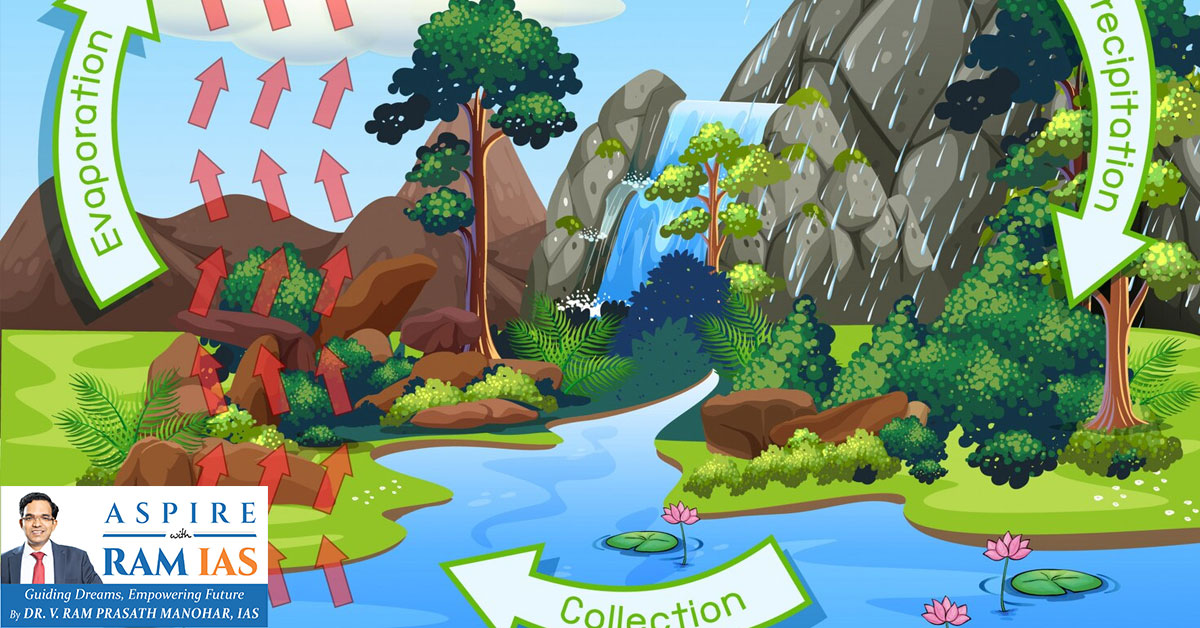
Biogeochemical (Nutrient) Cycles
- Movement of nutrients between biotic (living) and abiotic (air, water, soil) components.
- Nutrients are recycled, unlike energy, which is lost as heat.
- Major elements: C, N, O, H, P → ~97% of living matter.
Types
|
Basis |
Types |
|
Reservoir |
Gaseous (Atmosphere/Hydrosphere) & Sedimentary (Earth’s crust) |
|
Efficiency |
Perfect (fast recycling) & Imperfect (loss to sediments) |
Carbon Cycle (Gaseous Cycle)
- Carbon is present mainly as CO₂ in the atmosphere.
- Essential for photosynthesis → carbohydrates.
- Short-term cycle: Photosynthesis ↔ Respiration ↔ Decomposition.
- Long-term cycle: Fossil fuels, carbonate rocks, deep-sea sediments.
- Human role: Burning fossil fuels releases stored CO₂.
Adds CO₂: Respiration, decay, volcanic action
Removes CO₂: Photosynthesis
Nitrogen Cycle (Gaseous Cycle)
- Nitrogen is essential for proteins, amino acids, DNA, and chlorophyll.
- Atmospheric N₂ cannot be directly used by plants.
Main Steps
- Nitrogen Fixation:
N₂ → NH₃ / NH₄⁺ (by bacteria, lightning, industries) - Nitrification:
NH₃ → NO₂⁻ (Nitrosomonas) → NO₃⁻ (Nitrobacter) - Ammonification:
Organic waste → NH₃ - Denitrification:
NO₃⁻ → N₂ (Pseudomonas)
Excess fertilisers → Eutrophication, acid rain, groundwater pollution.
Phosphorus Cycle (Sedimentary Cycle)
- No gaseous phase (key difference from C & N cycles).
- Reservoir: Phosphate rocks (earth’s crust).
- Released by weathering → rivers → oceans.
- A major cause of eutrophication in freshwater bodies.
- Returns to land through geological uplift (very slow).
Sulphur Cycle (Sedimentary Cycle)
- Reservoir: Soil, rocks, fossil fuels.
- Exists as sulphates, sulphides, and organic sulphur.
- Has a minor gaseous phase (H₂S, SO₂).
- Sources: Volcanic eruptions, fossil fuel combustion, decomposition.
- SO₂ + rainwater → acid rain (H₂SO₄).
- Plants absorb sulphur as sulphates → proteins.
Key Pointers
- Gaseous cycles: Carbon, Nitrogen
- Sedimentary cycles: Phosphorus, Sulphur
- Main eutrophication nutrient: Phosphorus
- Acid rain contributors: Nitrogen oxides & Sulphur dioxide
- Fastest cycle: Gaseous
- Slowest cycle: Phosphorus
MCQs
Q1. Which one of the following nutrient cycles does NOT have a gaseous phase?
A. Carbon cycle
B. Nitrogen cycle
C. Phosphorus cycle
D. Sulphur cycle
Answer: C
Q2. The primary reservoir of phosphorus in nature is:
A. Atmosphere
B. Oceans
C. Earth’s crust
D. Living organisms
Answer: C
Q3. Which process converts ammonia into nitrites and nitrates in the nitrogen cycle?
A. Nitrogen fixation
B. Ammonification
C. Nitrification
D. Denitrification
Answer: C
Q4. Excessive use of nitrogenous fertilizers in agriculture can directly lead to:
A. Desertification
B. Eutrophication of water bodies
C. Ozone depletion
D. Soil salinity only
Answer: B
Q5. Which of the following gases is mainly responsible for acid rain formation in the sulphur cycle?
A. Carbon monoxide
B. Methane
C. Sulphur dioxide
D. Nitrogen
Answer: C
