
Environment
- Natural component where biotic (living) and abiotic (non-living) factors interact.
- Shapes the habitat and ecosystem of organisms.
- Includes physical (nutrients, water, air), biological (organisms, biomolecules), and chemical interactions (carbon, nitrogen cycles).
- All organisms depend on the environment for food, energy, water, oxygen, and shelter.
Biosphere
- Biological component of Earth supporting life: lithosphere, hydrosphere, atmosphere.
- Includes all living organisms + dead organic matter produced by them.
- Absent at extreme poles, the highest mountains, deepest oceans.
- Spores may occur above 8,000 m but are dormant, not metabolically active.
Habitat
- Physical environment where an organism lives (address of an organism).
- Many habitats together form an environment.
- One habitat may support multiple species with similar requirements (e.g., an aquatic habitat).
Difference: Habitat vs Environment
- Habitat always has life; environment may or may not.
- All habitats ⟹ environments; all environments ⟹ not habitats.
- Habitat = preference of one species; environment = may suit many species.
- The environment influences habitat, not vice versa.
Ecosystem
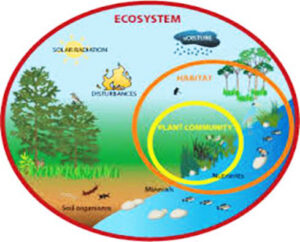
- A functional unit of nature where producers, consumers, and decomposers interact with the physical environment.
- Specific and limited species (e.g., aquatic ecosystem).
- Linked by nutrient cycles and energy flow.
- If one part is damaged, the entire system is affected.
Classification
- Terrestrial: Forest, grassland, desert
- Aquatic: Pond, lake, wetland, river, estuary
- Man-made: Crop fields, aquarium
Difference: Ecology, Environment & Ecosystem
- Ecology: Study of interactions between organisms and the environment.
- Environment: A Group of ecosystems (can be a large/small region).
- Biosphere: A Region on Earth that supports life.
- Habitat: Place where a species lives.
- Ecosystem: Producers–consumers–decomposers and their relationships (functional unit).
Components of an Ecosystem
Two types: Abiotic & Biotic
Abiotic Components
Non-living inorganic parts act as limiting factors.
Limiting Factor
- A single major factor that restricts survival.
- Example:
- Rainforest → soil heavily leached → poor soil = limiting factor → slow regeneration.
- Dense canopy → less light → saplings die → light = limiting factor.
Major Abiotic Factors
Light
- High intensity → more root growth; small leaves.
- Low intensity → poor growth, flowering, fruiting.
- Below minimum → plant death due to CO₂ accumulation.
- Red & blue light are effective for photosynthesis.
- Blue light → small plants; red → elongated; UV → dwarf.
Frost
- Freezes soil moisture → plants die from transpiration stress.
- Freezing water increases salt concentration → cell dehydration.
- Causes canker.
Snow
- Acts as a thermal blanket.
- Can break branches.
- Shortens vegetative growth period.
Temperature
- High temp → protein coagulation → plant death.
- Disturbs the balance between respiration & photosynthesis.
- Causes tissue desiccation.
- Dieback: shoots die, roots survive (e.g., sal).
Additional Factors
- Atmosphere: O₂ = 21%, CO₂ = 0.038%
- Organic compounds: proteins, carbohydrates, lipids
- Inorganic compounds: carbon, water, nitrates, phosphates
- Altitude: vertical zonation due to temperature changes
- Buffering capacity: maintains neutral pH
- Salinity:
- Euryhaline = wide tolerance
- Stenohaline = narrow tolerance
Biotic Components
1. Producers (Autotrophs)
- Green plants, bacteria, and algae perform photosynthesis.
- Aquatic primary producers: phytoplankton.
2. Consumers (Heterotrophs)
Macro-consumers:
- Herbivores (primary): sheep, rabbit
- Secondary: wolves, dogs, snakes
- Tertiary: lions, snakes
- Omnivores: humans, bears, pigs
3. Decomposers (Saprotrophs / Osmotrophs)
- Bacteria & fungi feed on dead organic matter.
- Detritivores: earthworms, nematodes, arthropods (feed on detritus; aid decomposition).
