
Modern History
Indian National Congress (INC)
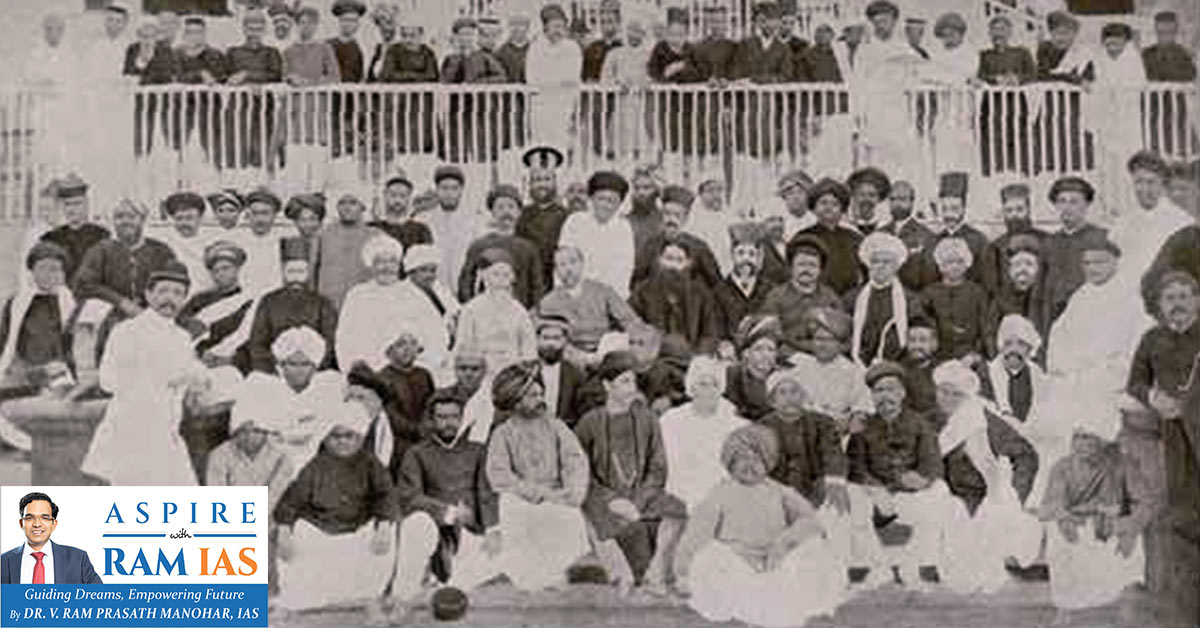
Foundation of the Indian National Congress (INC)
Overview
- The Indian National Congress (INC) was founded in 1885.
- It became the principal organisation leading India’s national movement.
- Played a crucial role in mobilising political awareness and nationalism.
Founder: A.O. Hume (retired British civil servant)
First Session: 28 December 1885
Place: Bombay (now Mumbai)
Venue: Gokuldas Tejpal Sanskrit College
First President: Womesh Chandra Bonnerjee
Delegates: 72 representatives from different parts of India.
Background of INC Formation
Before the INC, several regional political organisations emerged:
Important early political associations:
- Indian Association (1876) – Surendranath Banerjee
- Poona Sarvajanik Sabha (1870) – M.G. Ranade
- Madras Mahajan Sabha (1884)
- Bombay Presidency Association (1885)
These organisations created political awareness and nationalist sentiment.
Objectives of INC
- Promote personal friendship and unity among Indians.
- Remove prejudices based on caste, religion, and region.
- Develop national unity.
- Present opinions of educated Indians on public issues.
- Formulate political programs for public welfare.
Participation in the Early Congress
Dominant groups:
- Educated middle class
- Lawyers
- Professionals
Groups largely absent:
- Princes and zamindars
- Peasants
- Artisans
Thus, the early Congress was often called a middle-class organisation.
Theories on the Foundation of INC
1. Safety Valve Theory
Proposed that the British allowed INC to act as a “safety valve” for Indian discontent.
Proponents:
- Lala Lajpat Rai
- Some British officials
Idea:
- Congress would release growing political frustration peacefully.
2. Conspiracy Theory
Proposed by Rajani Palme Dutt.
According to this theory:
- Congress was created to prevent a mass uprising against British rule.
- The British and Indian elite collaborated.
3. Lightning Conductor Theory
Proposed by Gopal Krishna Gokhale.
Idea:
- INC acted as a “lightning conductor” channelling nationalist energy.
- It helped organize political demands of Indians.
Modern historians believe this theory is more realistic.
Important INC Sessions
|
Year |
Place |
President |
Outcome |
|
1885 |
Bombay |
W.C. Bonnerjee |
First session of INC |
|
1886 |
Calcutta |
Dadabhai Naoroji |
Formation of Provincial Congress Committees |
|
1887 |
Madras |
Badruddin Tyabji |
First Muslim President |
|
1888 |
Allahabad |
George Yule |
First English President |
|
1905 |
Banaras |
Gopal Krishna Gokhale |
Opposition to Bengal Partition |
|
1906 |
Calcutta |
Dadabhai Naoroji |
Goal of Swaraj declared |
|
1907 |
Surat |
Rash Behari Ghosh |
Moderate–Extremist split |
|
1916 |
Lucknow |
A.C. Mazumdar |
Lucknow Pact (Congress + Muslim League) |
|
1917 |
Calcutta |
Annie Besant |
First woman president |
|
1920 |
Calcutta (Special) |
Lala Lajpat Rai |
Non-Cooperation resolution |
|
1920 |
Nagpur |
C. Vijayaraghavachariar |
Reorganization of Congress |
|
1924 |
Belgaum |
M.K. Gandhi |
Only session chaired by Gandhi |
|
1925 |
Kanpur |
Sarojini Naidu |
First Indian woman president |
|
1929 |
Lahore |
Jawaharlal Nehru |
Purna Swaraj resolution |
|
1931 |
Karachi |
Vallabhbhai Patel |
Fundamental Rights resolution |
|
1937 |
Faizpur |
Jawaharlal Nehru |
First rural session |
|
1938 |
Haripura |
Subhas Chandra Bose |
National Planning Committee |
|
1939 |
Tripuri |
Subhas Chandra Bose |
Bose resigned after conflict |
|
1946 |
Meerut |
J.B. Kripalani |
Accepted Cabinet Mission Plan |
Significance of INC
1. Political Awakening
Created national political consciousness among Indians.
2. Platform for National Leaders
Leaders like:
- Dadabhai Naoroji
- Bal Gangadhar Tilak
- Gandhi
- Nehru
- Patel
emerged through Congress.
3. Organised Freedom Movement
INC coordinated major movements:
- Swadeshi Movement
- Non-Cooperation Movement
- Civil Disobedience Movement
- Quit India Movement
4. Development of Democratic Culture
Promoted:
- Debate
- Elections
- Constitutional politics
Key Facts
|
Feature |
Details |
|
Founded |
1885 |
|
Founder |
A.O. Hume |
|
First Session |
Bombay |
|
First President |
W.C. Bonnerjee |
|
Delegates |
72 |
|
First Muslim President |
Badruddin Tyabji |
|
First English President |
George Yule |
|
First Woman President |
Annie Besant |
|
First Indian Woman President |
Sarojini Naidu |
