
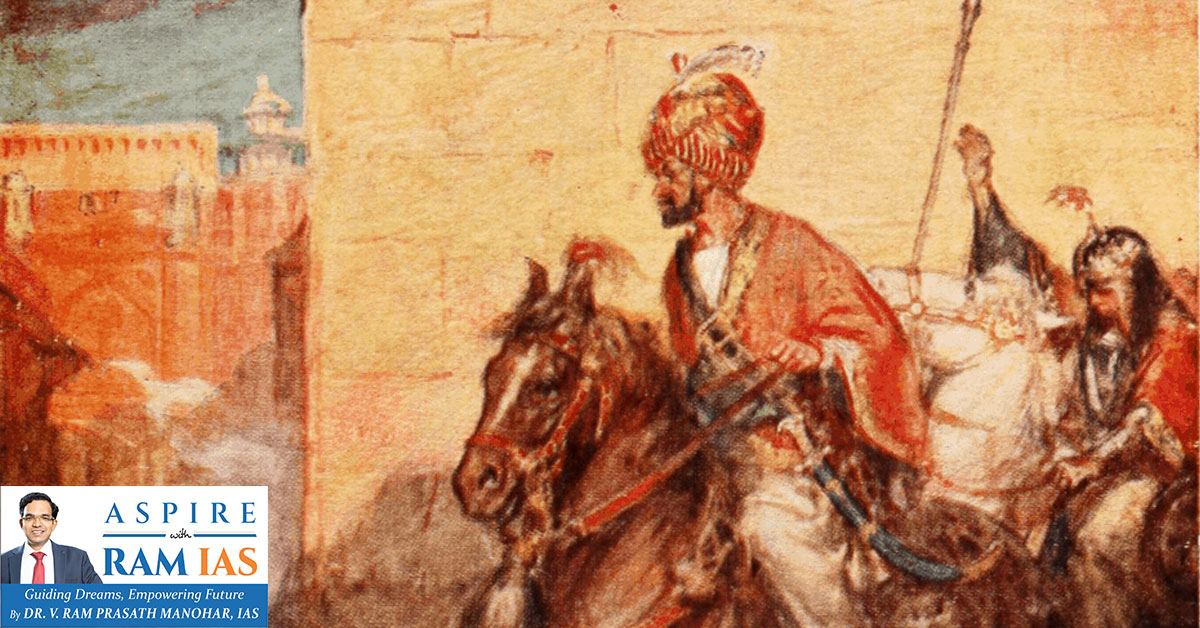
1. Background: Weakening of the Mughal Empire
Decline of the North-West Frontier Defence
- Under Aurangzeb, the north-west frontier (Kabul–Ghazni region) was well defended.
- Tribal chiefs were paid regular subsidies.
- Strong intelligence and communication existed between Kabul and Delhi.
Post-1707 Deterioration
- After Prince Muazzam left Kabul (1707):
- Administration became corrupt and careless
- Soldiers’ salaries remained unpaid for years
- Tribal subsidies were withheld
- Frontier provinces were neglected due to:
- Favouritism in appointments
- Jobbery and corruption
- Indifference of the Mughal court
2. Nadir Shah: Rise to Power
Early Life
- Born in 1688 in Khorasan (Turkoman Afshar tribe)
- Originally known as Nadir Quli
- Rose from poverty through military skill
Role in Persia
- Persia was under Afghan domination after:
- Capture of Isfahan (1722)
- Nadir expelled Afghans and restored Persian power
- Became Commander-in-Chief under the Safavid ruler Shah Tahmasp
Becoming Shah of Persia
- In 1736, Nadir overthrew the Safavids
- Assumed title Nadir Shah
- Founded the Afsharid Dynasty
3. Afsharid Dynasty
- Established: 1736
- Founder: Nadir Shah
- Capital region: Khorasan
- The Empire at its peak extended over:
- Iran, Afghanistan, parts of India (west of the Indus), the Caucasus
- Declined after Nadir Shah’s assassination (1747)
4. Causes of Nadir Shah’s Invasion of India
Immediate Causes
- Afghan fugitives sheltered in Kabul & Ghazni
- Mughal failure to honour promises
- The attack and killing of Nadir’s envoy at Jalalabad
- Discontinuation of Mughal–Persian diplomatic exchange
Fundamental Causes
- Ambition and the military expansionism of Nadir Shah
- Extreme weakness of the Mughal Empire
- Knowledge of India’s immense wealth
- Invitations and goodwill letters from discontented Mughal nobles
- Internal factionalism at the Delhi court
5. Course of the Invasion
Entry into India
- Ghazni captured: 11 June 1738
- Kabul captured: 29 June 1738
- Mughal governors surrendered without resistance
- Crossed the Indus at Attock
- Lahore subdued easily
6. Battle of Karnal (24 February 1739)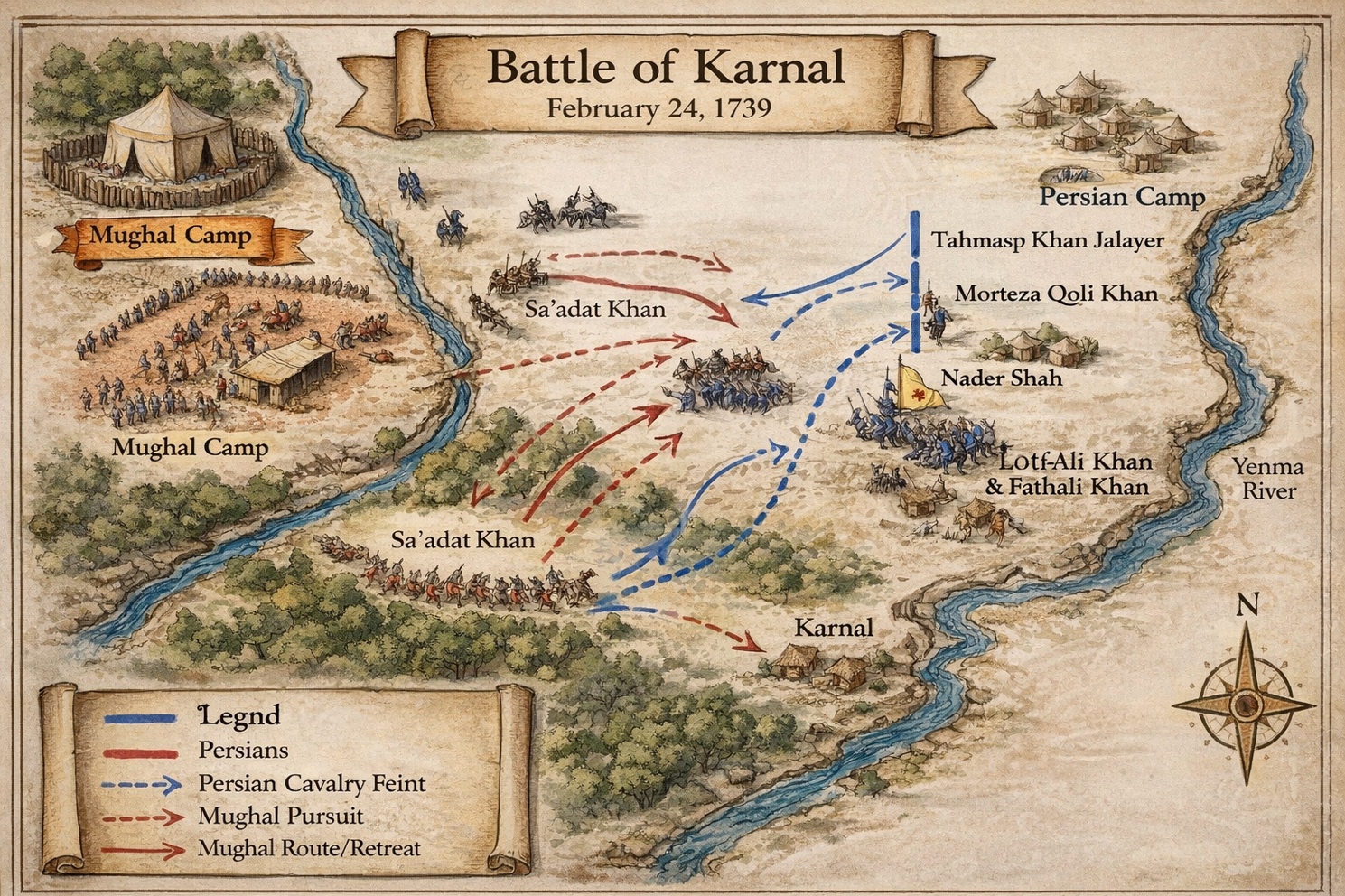
Mughal Side
- Emperor: Muhammad Shah
- Army: ~80,000 soldiers
- Leaders: Nizam-ul-Mulk, Saadat Khan, Khan-i-Dauran
- Poor coordination and rivalry
Persian Side
- Highly disciplined and experienced army
- Clear leadership under Nadir Shah
Outcome
- The battle lasted only 3 hours
- Khan-i-Dauran killed
- Saadat Khan captured
- Crushing Mughal defeat
7. March to Delhi & Sack of the City
- Nadir entered Delhi on 20 March 1739
- Khutba read, and coins struck in Nadir’s name
- Rumour of Nadir’s death led to an uprising
- Nadir ordered a general massacre
- ~30,000 people killed
- Stopped only after Muhammad Shah’s request
8. Loot and Return
Enormous Booty
- ~30 crores rupees in cash
- Gold, silver, jewels
- Peacock Throne
- Animals and skilled artisans were taken to Persia
Territorial Losses
- Mughal territories west of the Indus surrendered:
- Kabul
- Kashmir
- Sindh
- Annual tribute from Punjab
Political Arrangement
- Muhammad Shah was restored as the Mughal emperor
- Mughal sovereignty became symbolic
9. Peacock Throne
- Built by Shah Jahan
- Located in Diwan-i-Khas, Red Fort
- Adorned with emeralds, rubies, and diamonds
- Taken to Persia by Nadir Shah
- Destroyed after his death (1747)
10. Impact of Nadir Shah’s Invasion
On the Mughal Empire
- Complete loss of prestige
- Severe financial ruin
- Breakdown of north-west defence
- Increased exploitation of peasants
- Intensified noble factionalism
Long-Term Consequences
- Exposed India to repeated Afghan invasions
- Encouraged Ahmad Shah Abdali (1748–1767)
- Strengthened:
- Marathas
- European trading companies
