
Study Materials
General Studies - Polity
Parliamentary Form of Government
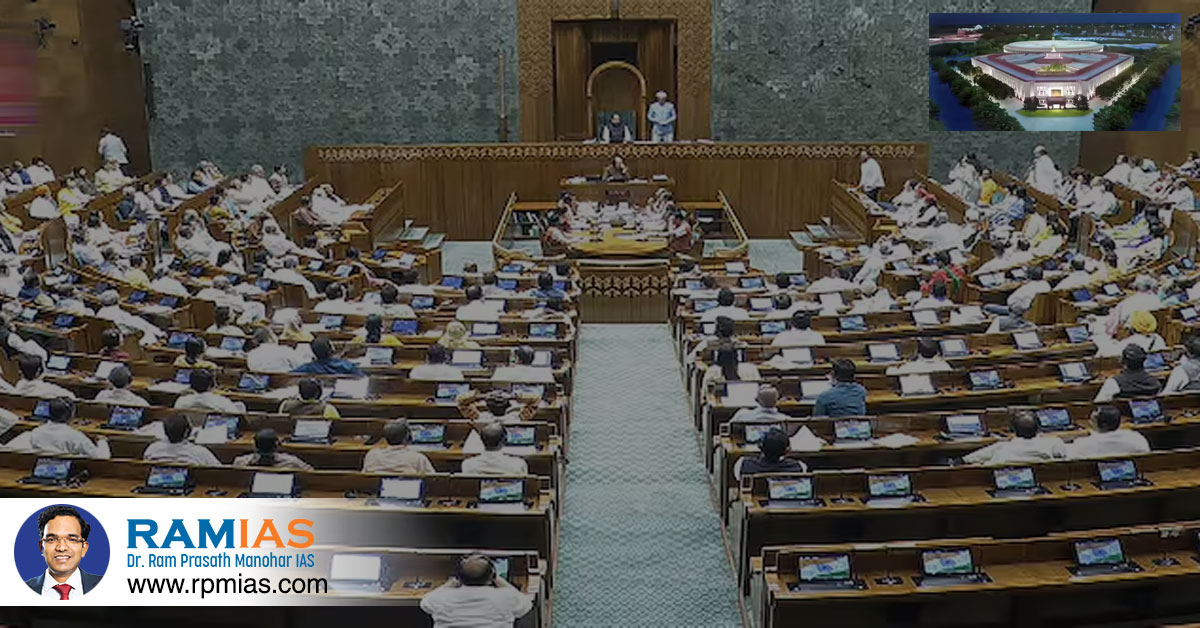
1. Meaning
A parliamentary system is a democratic structure where:
- The party with the majority in the legislature forms the government.
- The executive (PM + Ministers) comes from the legislature and remains answerable to it.
- India follows the British model.
2. Why Is It Called “Parliamentary”?
Because Parliament controls the Executive through confidence, questions, debates, motions, and committees.
3. Core Features
- Nominal & Real Executive
- President → nominal (de jure).
- PM → real (de facto).
- Executive from the Legislature
- PM and Ministers are MPs.
- Dual membership ensures linkage.
- Collective Responsibility
- The entire Cabinet is responsible to the Lok Sabha.
- Prime Ministerial Leadership
- PM is the pivot of policy and administration.
- Majority Party Rule
- Leader of the majority becomes PM.
- No Fixed Tenure
- The government survives only while it enjoys Lok Sabha confidence.
- Secret Cabinet Meetings
- Ensures frank discussion.
- Bicameral Legislature
- Lok Sabha + Rajya Sabha.
- Political Homogeneity
- Ministers usually share the same ideology (coalition → common agenda).
4. Constitutional Provisions
Article | Level | Provision |
74 | Union | CoM to aid & advise the President |
75 | Union | Appointment; CoM is responsible to the Lok Sabha |
163 | State | CoM aids & advises the Governor |
164 | State | Appointment; CoM is responsible to the Assembly |
5.Advantages
- Executive–Legislature Coordination
Smooth lawmaking, quicker implementation. - Responsible Government
Questions, debates, and motions ensure accountability. - Prevents Dictatorship
Power is divided among a team, not one individual. - Broad Representation
Ministers from various regions/castes/communities.
6. Disadvantages
- No Real Separation of Powers
A majority government can dominate Parliament.
- Instability
Coalitions may collapse; frequent elections.
- Weak Lawmaking Quality
MPs aspire to become ministers → less policy expertise.
- Bureaucratic Influence
Civil servants often shape decisions more than ministers.
- Slow Decision-Making
Political calculations delay long-term reforms.
7. Parliamentary System vs Presidential System
Feature | Parliamentary | Presidential |
Head of State | President (ceremonial) | President (executive) |
Head of Govt | PM | President |
Executive-Legislature Relation | Fused | Separated |
Responsibility | Collective to the legislature | Independent |
Tenure | Not fixed | Fixed |
Removal | No-confidence | Impeachment |
Stability | Less | More |
Decision-making | Collective | Independent |
A parliamentary system blends accountability with flexibility, making it suitable for diverse, democratic, and coalition-driven societies like India.
