
What is a Planet?
A planet is a celestial body that:
- Revolves around a star (Sun)
- Moves in an elliptical orbit
- Does not emit its own light
All 8 planets revolve around the Sun counter-clockwise (as seen from above the Sun’s north pole).
Classification of Planets
Basis | Inner Planets | Outer Planets |
Other name | Terrestrial planets | Jovian / Gas Giants |
Position | Between Sun and Asteroid Belt | Beyond the Asteroid Belt |
Composition | Rock & metals | Hydrogen, helium & ices |
Density | High | Low |
Atmosphere | Thin or moderate | Thick |
Moons | Few or none | Many |
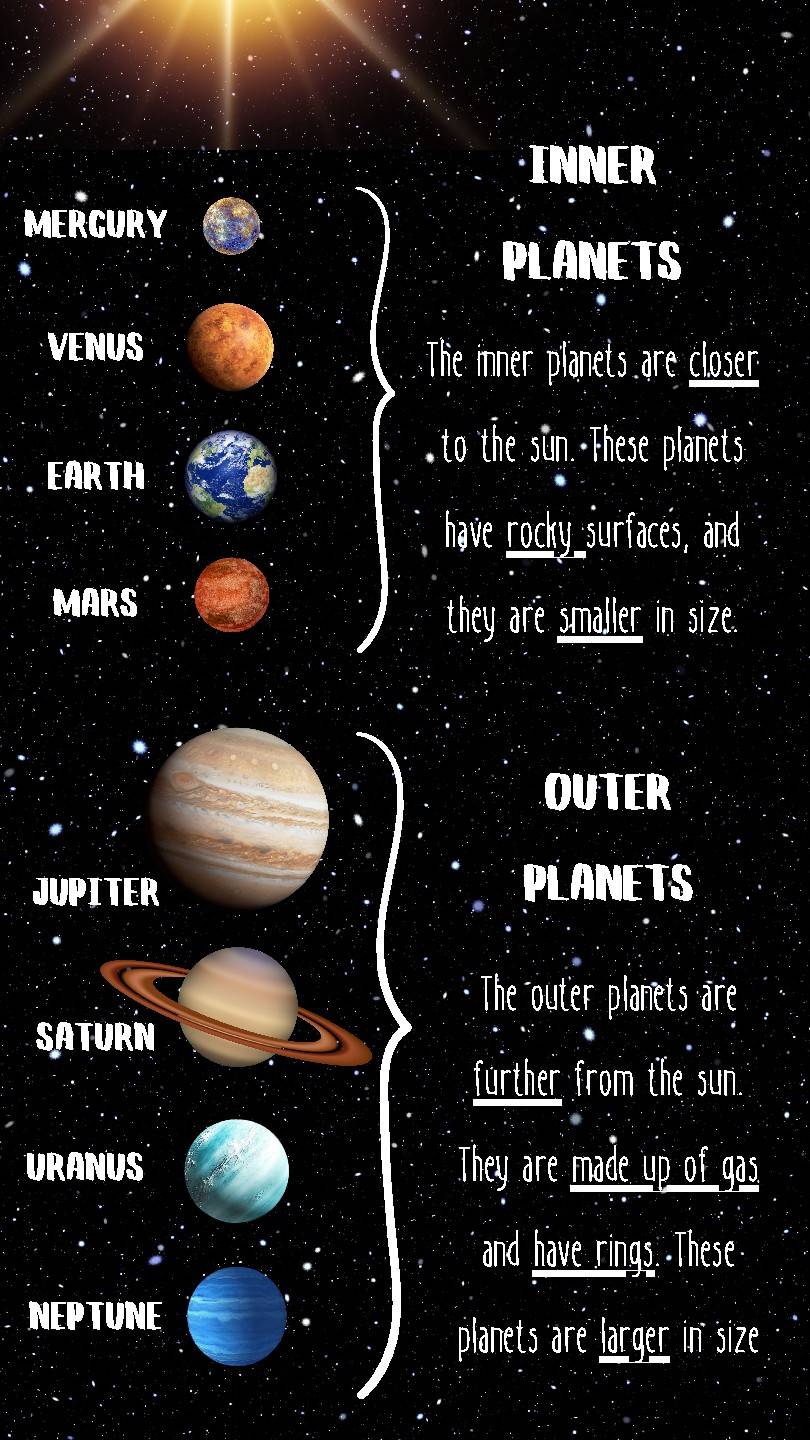
Inner Planets (Terrestrial Planets)
Members
- Mercury
- Venus
- Earth
- Mars
Key Features
- Made of silicates + iron & nickel core
- Smaller but denser
- Solid rocky surface
- Impact craters, volcanoes, and rift valleys are common
- Venus, Earth & Mars have atmospheres
Mercury
- Closest planet to the Sun
- Almost no atmosphere
- Extreme temperature variation
- Day: +427°C
- Night: −173°C
- Heavily cratered → geologically inactive
- Smaller than moons Ganymede & Titan, but more massive
- MESSENGER mission found:
- Evidence of volcanism
- Water ice at the poles
Seen only near the horizon during sunrise/sunset
Venus
- Brightest planet (highest albedo)
- Called Morning Star / Evening Star
- Thick atmosphere: 96% CO₂
- The hottest planet due to the extreme greenhouse effect
- Atmospheric pressure = 92 times Earth’s
- Retrograde rotation (clockwise)
- One day (243 Earth days) > one year (224 days)
Known as Earth’s twin (size & mass similar, conditions opposite)
Earth
- Densest planet in the Solar System
- Only known planet supporting life
- One moon
- Axial tilt: 5° → seasons
- Balanced atmosphere & liquid water
Mars
- Known as the Red Planet (iron oxide)
- Thin atmosphere (≈96% CO₂)
- Lost magnetosphere → atmosphere stripped by solar wind
- Evidence of past liquid water
- Water is now locked in polar ice caps
- Largest volcano: Olympus Mons
- Largest canyon: Valles Marineris
- Two moons: Phobos & Deimos
- Seasons similar to Earth
Methane presence suggests an active geological or biological source
The Moon (Earth’s Satellite)
Key Facts
- Diameter = ¼ of Earth
- Distance from Earth ≈ 3,84,400 km
- Tidally locked → only one side visible
- Stabilises Earth’s axial tilt
Formation
- Giant Impact Theory (“Big Splat”)
- A Mars-sized body collided with early Earth
Important Discoveries
- Luna-2 (1959) → first object to reach the Moon
- Apollo-11 (1969) → first humans on Moon
- Chandrayaan-1 (2009) → water at lunar poles
Outer Planets
Members
- Jupiter
- Saturn
- Uranus
- Neptune
- (Pluto → dwarf planet)
General Features
- Composed mainly of hydrogen & helium
- No solid surface
- Thick atmospheres
- Strong magnetospheres
- Rings & numerous moons
- Account for 99% of planetary mass
Gas Giants vs Ice Giants
Type | Planets | Composition |
Gas Giants | Jupiter, Saturn | Hydrogen & Helium |
Ice Giants | Uranus, Neptune | Water, ammonia, methane |
Why are Inner Planets Rocky & Outer Planets are Gaseous?
- Inner planets formed close to the Sun
- High temperature → gases could not condense
- Strong solar wind blew away gases
- Smaller gravity → could not retain gases
- Outer planets formed farther → cooler → gases condensed & retained
Jupiter
- Largest planet
- Rapid rotation → equatorial bulge
- No solid surface
- Four Galilean moons:
- Io, Europa, Ganymede, Callisto
- Ganymede → largest moon in the Solar System
- Latest mission: Juno
Saturn
- Least dense planet → can float on water
- Prominent ring system
- Moon Titan:
- Nitrogen-rich atmosphere
- Only the moon with a dense atmosphere
Uranus
- Rotates on its side
- Axis almost parallel to orbital plane
- Retrograde rotation
- Extreme seasons
Neptune
- Strongest winds in the Solar System (~2100 km/h)
- Ice giant
- Twin of Uranus
