
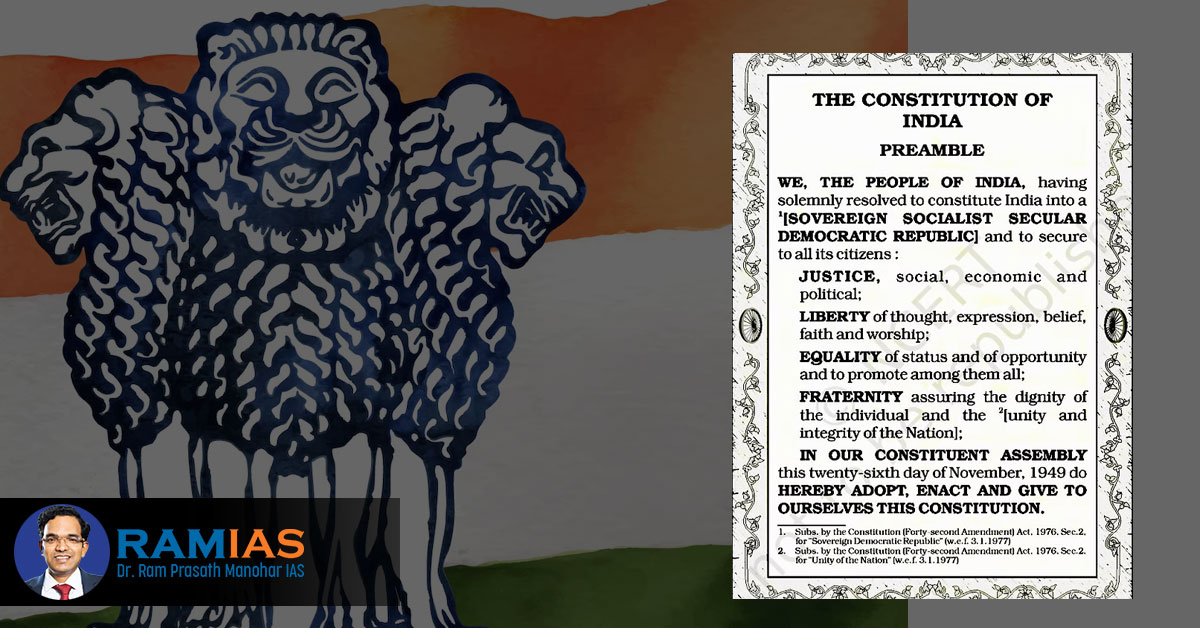
- The Preamble of the Indian Constitution embodies the nation’s core ideals, declaring India to be a Sovereign, Socialist, Secular, Democratic Republic committed to securing Justice, Liberty, Equality, and Fraternity for all its citizens.
- It is derived from Jawaharlal Nehru’s Objective Resolution adopted in 1947 and serves as a guiding light for interpreting the spirit of the Constitution.
Evolution of the Preamble
- Objective Resolution (December 13, 1946): Introduced by Jawaharlal Nehru, it declared India an Independent Sovereign Republic, uniting British India and princely states into a single Union. It emphasized that all authority flows from the people and guaranteed justice, liberty, equality, and safeguards for minorities and weaker sections.
- Drafting the Preamble:N. Rau prepared the initial draft, later refined and presented to the Constituent Assembly on July 4, 1947. After deliberation, it was adopted on January 22, 1947, and became part of the Constitution enacted on November 26, 1949, and enforced on January 26, 1950.
Components of the Preamble
Component | Explanation |
Source of Authority | Begins with “We, the people of India” — the Constitution derives its power from the people, not an external authority. |
Nature of the State | Declares India as a Sovereign, Socialist, Secular, Democratic, and Republic. |
Objectives of the Constitution | Promises Justice, Liberty, Equality, and Fraternity. |
Adoption Date | Mentions November 26, 1949, as the date of adoption. |
Ideals of the State
Term | Meaning | Explanation |
Sovereign | Supreme authority | India is free from external control and has the power to make its own laws, both internally and externally. |
Socialist | Economic and social equality | Added by the 42nd Amendment (1976), emphasizing equitable distribution of wealth and opportunities. Reflected in the Directive Principles of State Policy. |
Secular | Equal respect for all religions | No state religion; citizens have the freedom to profess, practice, and propagate any faith. |
Democratic | Power vested in the people | People elect their representatives through free and fair elections. Ensures government of the people, by the people, for the people. |
Republic | Elected head of state | India’s head of state (President) is elected, not hereditary — ensuring equality and popular sovereignty. |
Aspirations of the People
Aspirations | Explanation |
Justice | Ensures social, economic, and political justice through Fundamental Rights and Directive Principles. |
Liberty | Freedom of thought, expression, belief, faith, and worship is guaranteed under Fundamental Rights. |
Equality | Equality before law and equal opportunity to all, reflected in Articles 14–18. Also includes positive equality through affirmative action. |
Fraternity | Promotes a sense of brotherhood and ensures the dignity of the individual and the unity of the nation. |
Judicial Interpretation: Preamble as a Part of the Constitution
Case | Judgement |
Berubari Union Case (1960) | SC held that the Preamble is not a part of the Constitution and cannot be used for interpretation. |
Kesavananda Bharati Case (1973) | Reversed the Berubari decision; held that the Preamble is part of the Constitution and forms part of its Basic Structure. |
LIC of India Case (1995) | Reaffirmed that the Preamble is integral to the Constitution, though not enforceable in court. |
Amendment to the Preamble
- The 42nd Constitutional Amendment Act, 1976, amended the Preamble.
- Added three new terms: “Socialist,” “Secular,” and “Integrity.”
- Confirmed by the Supreme Court that while the Preamble can be amended under Article 368, it cannot violate the basic structure.
UPSC Prelims PYQs:
- The Preamble to the Constitution of India is
- A part of the Constitution but has no legal effect
- Not a part of the Constitution and has no legal effect either
- Part of the Constitution and has the same legal effect as any other part
- A part of the Constitution but has no legal effect independently of other parts
Answer: (d)
- Which one of the following objectives is not embodied in the Preamble to the Constitution of India?
- Liberty of thought
- Economic liberty
- Liberty of expression
- Liberty of belief
Answer: (b)
- The mind of the makers of the Constitution of India is reflected in which of the following?
- The Preamble
- The Fundamental Rights
- The Directive Principles of State Policy
- The Fundamental Duties
Answer: (a)
- ‘Economic Justice’, the objective of the Constitution has been one of the Indian provided in
- The Preamble and Fundamental Rights
- The Preamble and the Directive Principles of State Policy
- The Fundamental Rights and the Directive Principles of State Policy
- None of the above
Answer: (b)
