
Study Materials
General Studies - Polity
President of India
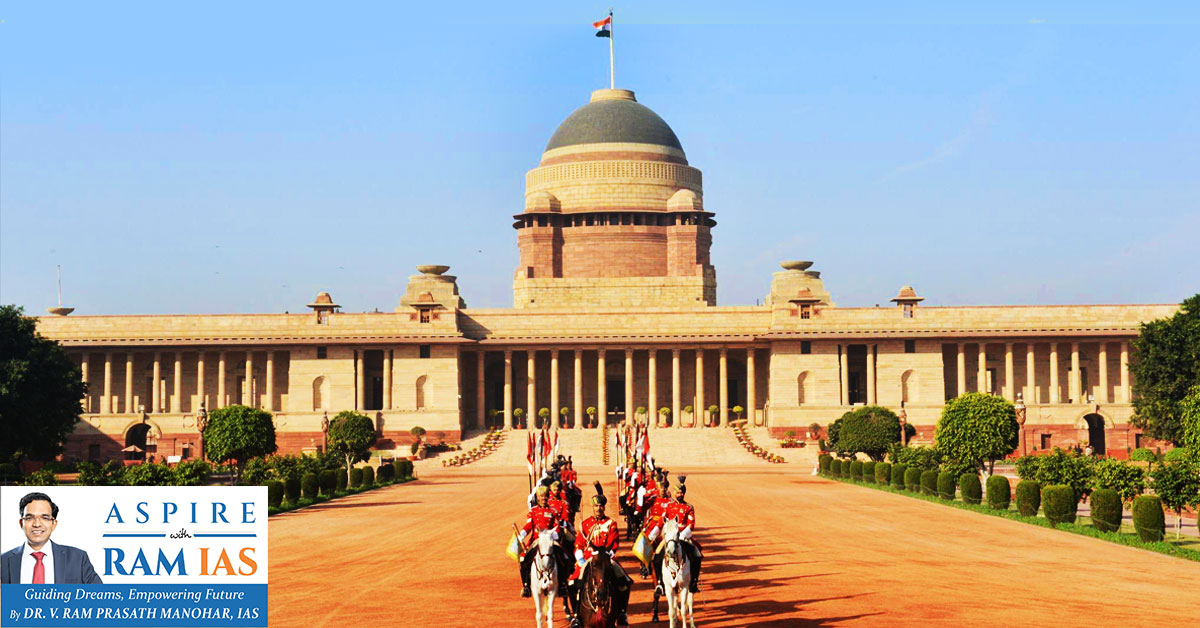
1. Constitutional Position
Article 52 → “There shall be a President of India.”
- Head of State and First Citizen of India.
- Supreme Commander of the Armed Forces.
- Appoints:
- Prime Minister, other Union Ministers
- Judges of the Supreme Court & High Courts
- Governors of States
- Acts mainly as a constitutional figurehead;
Real executive power → Prime Minister + Council of Ministers (Art. 74).
2. Election of the President
Electoral College (Art. 54):
Includes ONLY elected members of:
- Lok Sabha
- Rajya Sabha
- State Legislative Assemblies
- Legislative Assemblies of Delhi & Puducherry
Excluded from voting:
- Nominated members (Parliament/State Assemblies)
- MLCs (State Legislative Councils)
- Nominated MLAs in Delhi/Puducherry
Voting System (Art. 55):
- Proportional Representation,
- Single Transferable Vote (STV)
- Secret ballot
- Each elector has one vote, but votes carry value.
3. Process of Election
- ECI announces election schedule + invites nominations.
- Candidate must have:
- 50 proposers
- 50 seconders (from Electoral College)
- Must be:
- Citizen of India
- 35 years old
- Eligible to be a Lok Sabha member
- Nomination scrutinized → valid candidates notified.
- Electors cast a vote using STV.
- Majority vote → candidate declared President.
- President-elect takes oath (Art. 60).
4. Constitutional Articles
| Article | Provision |
| 52 | President of India |
| 53 | Executive power vested in the President |
| 54 | Election by Electoral College |
| 55 | Manner of election |
| 56 | Term: 5 years |
| 57 | Eligibility for re-election |
| 58 | Qualifications |
| 59 | Conditions of office |
| 60 | Oath of office |
| 61 | Impeachment procedure |
| 62 | Term expiry & vacancy provisions |
5. Qualifications (Art. 58)
Candidate must:
- Be a citizen of India
- Be 35 years or above
- Be qualified to be a member of the Lok Sabha
- Not hold office of profit
Exceptions (can hold office and still contest):
- Sitting President
- Sitting Vice-President
- Governor of any State
- Union/State Ministers
6. Oath of Office (Art. 60)
Swears to:
- Faithfully execute office
- Preserve, protect, and defend the Constitution and the law
- Devoted to the service & well-being of the people
Administered by: Chief Justice of India (or senior-most SC judge available)
7. Conditions of Office (Art. 59)
- Must not be MP or MLA; the seat becomes vacant upon assuming office.
- Must not hold any other office of profit.
- Entitled to Rashtrapati Bhavan (rent-free).
- Receives emoluments/allowances as determined by Parliament.
- Salary cannot be reduced during the term.
8. Term and Vacancy (Art. 56 & 62)
Term:
- 5 years from entering office.
- Continues until successor assumes office.
- Eligible for unlimited re-election (unlike the U.S., where max = 2 terms).
Vacancy arises due to:
- Expiry of term
- Resignation (to Vice-President)
- Impeachment
- Death
- Disqualification/election declared void
9. Impeachment of the President (Art. 61)
- Ground: “Violation of the Constitution”
(Not defined in the Constitution) - It can be initiated by either House of Parliament.
- Requires:
- Notice signed by 1/4th the members of the initiating House
- 14 days’ notice to the President
- Passed by:
- 2/3rd majority of the total membership of both Houses
Important:
- Nominated MPs can participate in impeachment.
- State MLAs cannot participate (even though they vote in the election).
No President has been impeached so far.
MCQs
Q1. Which Article of the Constitution states that “There shall be a President of India”?
A. Article 50
B. Article 52
C. Article 53
D. Article 54
Answer: B
Q2. Who elects the President of India?
A. All MPs and all MLAs
B. Elected MPs and elected MLAs only
C. MPs, MLAs, and MLCs
D. Only Lok Sabha
Answer: B
(Elected members of Parliament + Elected members of State/Delhi/Puducherry Legislative Assemblies)
Q3. Which of the following is NOT part of the Electoral College for Presidential elections?
- Nominated members of the Rajya Sabha
- Elected members of State Legislative Assemblies
- Elected members of the Lok Sabha
- Nominated members of State Legislative Councils
A. 1 and 4 only
B. 2 and 3 only
C. 1, 3, and 4 only
D. 1, 2, and 4 only
Answer: A
(Nominated members do NOT vote; MLCs do NOT vote)
Q4. The President must meet qualifications to be a member of which House?
A. Rajya Sabha
B. Lok Sabha
C. Either House
D. Both Houses
Answer: B
Q5. Impeachment of the President requires:
A. Simple majority of both Houses
B. Two-thirds majority of the total membership of both Houses
C. Two-thirds majority of members present and voting in both Houses
D. Three-fourths majority of the total membership of Parliament
Answer: C
Q6. Who administers the oath of office to the President of India?
A. Prime Minister
B. Vice-President
C. Chief Justice of India
D. Speaker, Lok Sabha
Answer: C
