
Study Materials
General Studies - Geography
Solar System: Core Components
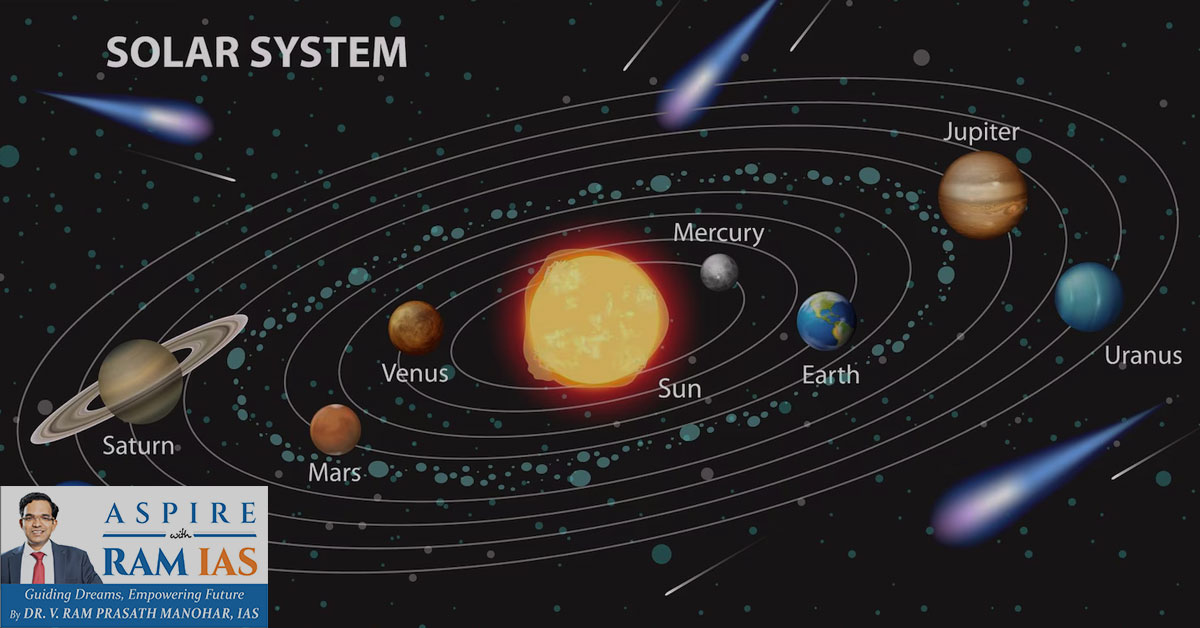
Solar System: Core Components
- Sun: ~99.86% of the total mass of the solar system; source of energy via nuclear fusion.
- Planets: 8 (Mercury → Neptune).
- Dwarf planets: Pluto, Ceres, Eris, Haumea, Makemake.
- Natural satellites: Moons orbiting planets.
- Small bodies:
- Asteroids (mainly between Mars and Jupiter)
- Comets (highly elliptical orbits)
- Meteoroids / Meteors / Meteorites
Heliocentric Model & Orbits
- Nicolaus Copernicus: Proposed heliocentric theory (Sun at centre).
- Ecliptic Plane:
- Most planets orbit close to it
- Comets & Kuiper Belt objects are often highly inclined
- Orbital Shape:
- Planets → nearly circular
- Comets → highly elliptical
Early Ideas on Earth’s Shape
- Pythagoras: First proposed spherical Earth (~500 BC)
- Aristotle: Provided scientific evidence (340 BC)
- Ptolemy: Geocentric model
- Copernicus: Refuted the geocentric model
- Strabo: Descriptive geography (Geographica)
Kepler’s Laws of Planetary Motion
- Planetary orbits are elliptical, with the Sun at one focus
- Equal areas swept in equal time
- ( T^2 \propto a^3 ) (orbital period ∝ semi-major axis³)
Classification of Planets
Inner (Terrestrial) Planets
- Mercury, Venus, Earth, Mars
- Rocky, dense, fewer/no moons, no rings
Outer (Jovian) Planets
- Jupiter, Saturn, Uranus, Neptune
- Gaseous/icy, rings present, many moons
Planets & Their Major Moons
- Earth → Moon
- Mars → Phobos, Deimos
- Jupiter → Io, Europa, Ganymede*, Callisto
- Saturn → Titan*, Enceladus
- Uranus → Titania, Oberon, Ariel, Umbriel
- Neptune → Triton* (retrograde orbit)
*Ganymede = the largest moon in the solar system
*Titan = dense atmosphere
*Triton = retrograde rotation
Key Planet-wise Facts
Mercury
- Closest to the Sun
- No atmosphere, no moons
- Extreme temperature variation
Venus
- Hottest planet (greenhouse effect)
- Retrograde rotation
- No moons
Earth
- The only known planet with life
- Liquid water, oxygen-rich atmosphere
Mars
- “Red Planet” (iron oxide)
- Evidence of past water
Jupiter
- Largest planet
- Great Red Spot
- Strongest magnetic field
Saturn
- Lowest density (can float in water – conceptually)
- Prominent ring system
Uranus
- Rotates on its side (axial tilt ~98°)
- Coldest atmosphere
Neptune
- Fastest winds
- Farthest planet from the Sun
Dwarf Planet – Pluto
- Kuiper Belt object
- Highly elliptical orbit
- Not cleared orbital neighbourhood
- Moon: Charon
Comparisons
- Largest planet: Jupiter
- Largest moon: Ganymede
- Hottest planet: Venus
- Fastest rotation: Jupiter
- Retrograde moon: Triton
- Retrograde planet: Venus, Uranus (effectively)
MCQs
Q1. Consider the following statements about the ecliptic plane:
- Most planets orbit the Sun close to the ecliptic plane.
- Kuiper Belt objects generally have orbits highly inclined to the ecliptic.
- All comets move strictly within the ecliptic plane.
Which of the statements given above are correct?
(a) 1 and 2 only
(b) 2 and 3 only
(c) 1 only
(d) 1, 2, and 3
Answer: a
Q2. Which one of the following moons of the solar system shows a retrograde orbit around its parent planet?
(a) Titan
(b) Ganymede
(c) Triton
(d) Europa
Answer: c
Q3. Which of the following planets has the lowest mean density?
(a) Jupiter
(b) Saturn
(c) Uranus
(d) Neptune
Answer: b
Q4. Which one of the following statements regarding Kepler’s Laws of Planetary Motion is correct?
(a) Planetary orbits are circular with the Sun at the centre
(b) Equal areas are swept in unequal intervals of time
(c) The square of the orbital period is proportional to the cube of the semi-major axis
(d) Orbital period is inversely proportional to distance from the Sun
Answer: c
