
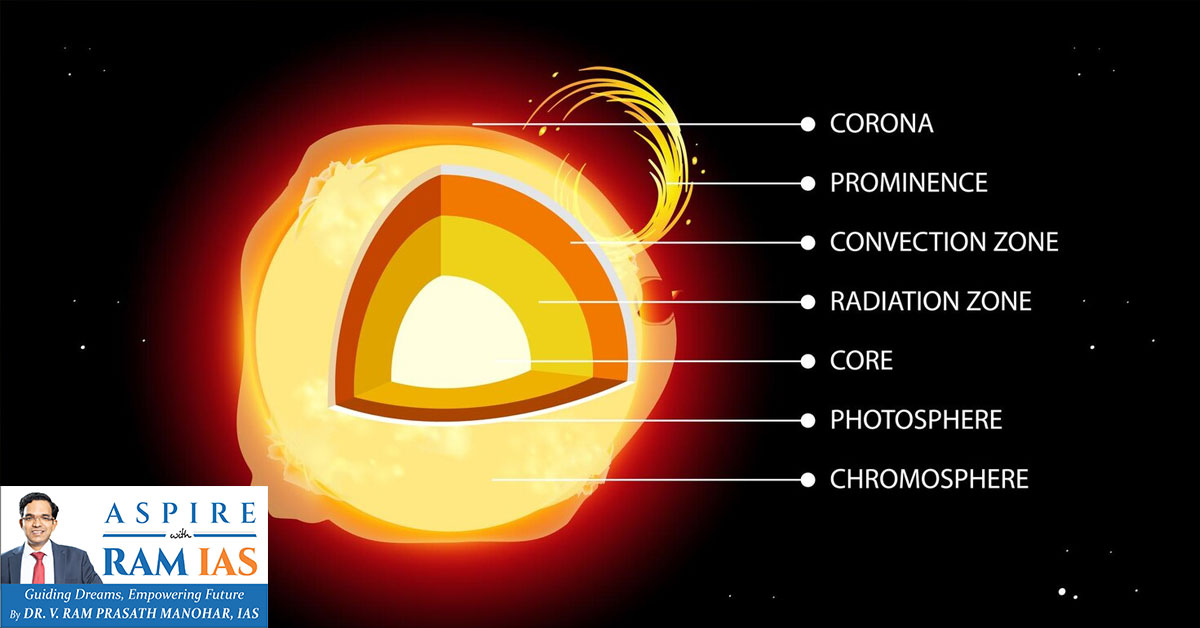
THE SUN
- Age: ~4.6 billion years
- Diameter: ~1.39 million km
- Surface Temperature: ~6000 °C
- Core Temperature: ~16 million °C
- Mass: ~3,32,900 times Earth
- Composition: ~98% Hydrogen & Helium
- Gravity: 274 m/s² (≈28× Earth)
- Rotation Period: ~25 days 9 hours (differential rotation)
- Rotation Direction: Counter-clockwise (viewed from above Earth’s North Pole)
- Solar System Mass: ~99.8% concentrated in the Sun
Note: Despite its huge mass, the Sun has only ~2% angular momentum due to its gaseous nature.
INTERNAL STRUCTURE OF THE SUN
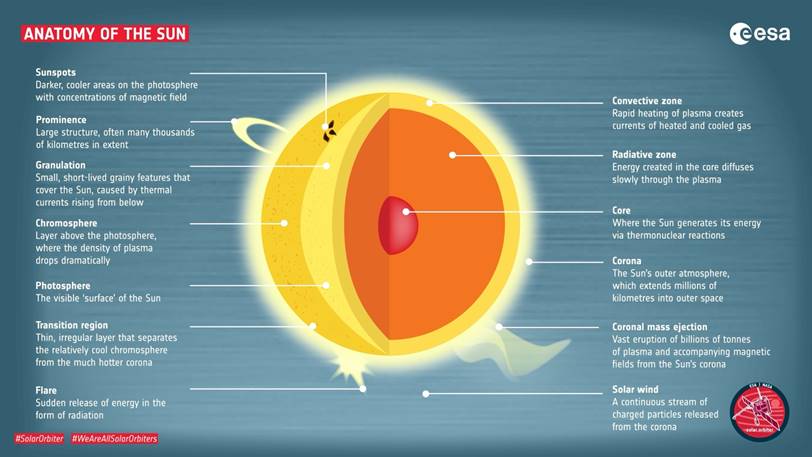
1. Core
- Innermost region
- Site of nuclear fusion (Hydrogen → Helium)
- Source of solar energy
2. Radiative Zone
- Energy is transferred outward by radiation
- Photons take thousands of years to escape
3. Convective Zone
- Energy transferred by convection currents
- Hot plasma rises, cooler plasma sinks
ATMOSPHERIC LAYERS OF THE SUN
1. Photosphere
- Visible “surface” of the Sun
- Emits most solar radiation
- Temperature: ~6000 °C
- Sunspots occur here
2. Chromosphere
- Thin layer above the photosphere
- Temperature: ~4320 °C
- Appears reddish during solar eclipses
3. Corona
- Outermost atmosphere
- Temperature: ~1 million °C
- Extends millions of km into space
- Source of Solar Wind
- Visible during a total solar eclipse
SUNSPOTS
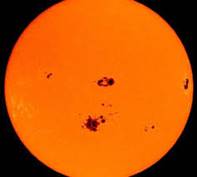
- Dark patches on the photosphere
- Cooler (500–1500 °C less than surroundings)
- Caused by strong magnetic fields inhibiting convection
- Have:
- Umbra (dark center)
- Penumbra (lighter outer region)
- 11-year sunspot cycle
- Solar Maximum → high sunspots
- Solar Minimum → low sunspots
- Linked to solar storms & climate variations
SOLAR WIND
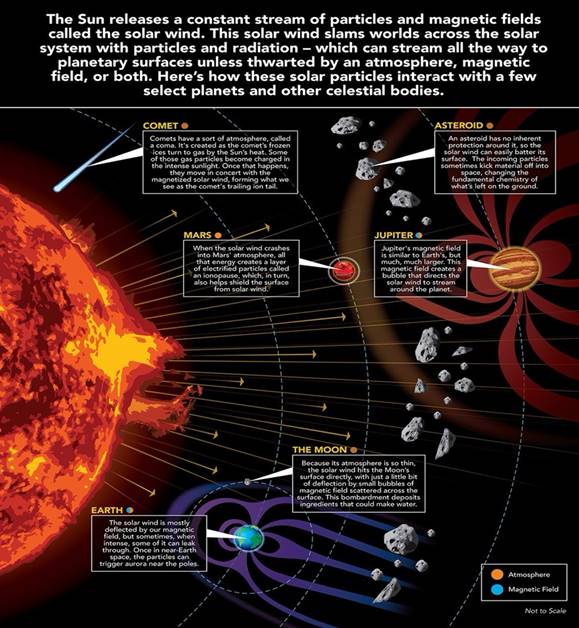
- Continuous outflow of charged particles (plasma)
- Originates from the corona
- Speed: up to 900 km/s
- Temperature: ~1 million °C
- Main components: electrons & protons
Impacts:
- Causes auroras
- Can disrupt satellites, GPS, and power grids
PLASMA
- Fourth state of matter
- Ionised gas (free electrons + ions)
- Examples:
- Lightning
- Electric sparks
- Neon lights
- Solar wind
AURORA
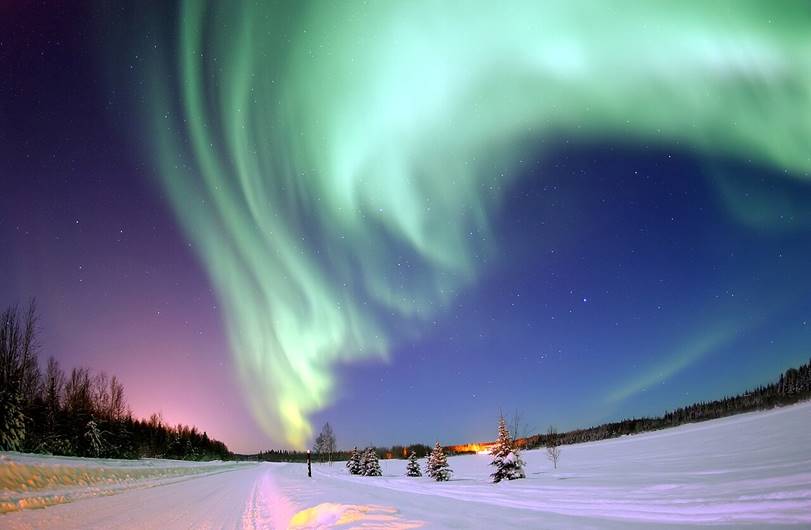
- Natural light display near polar regions
- Caused when solar wind particles interact with Earth’s magnetic field & atmosphere
- Types:
- Aurora Borealis (North)
- Aurora Australis (South)
SOLAR FLARES
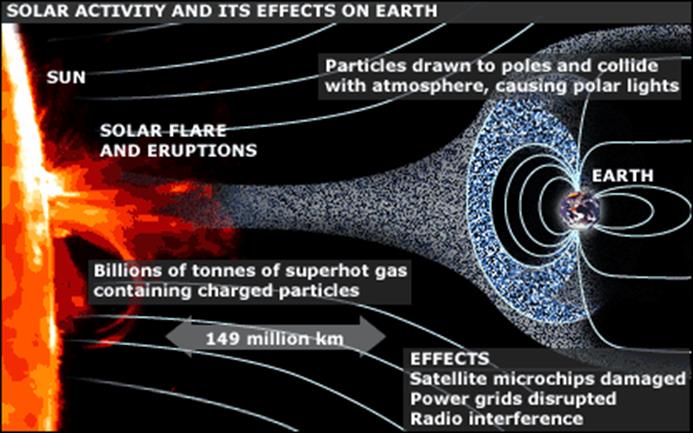
- Sudden magnetic explosions on the Sun
- Extremely bright
- Heat corona to 10–20 million °C
- Can cause:
- Radio blackouts
- Satellite damage
SOLAR PROMINENCE
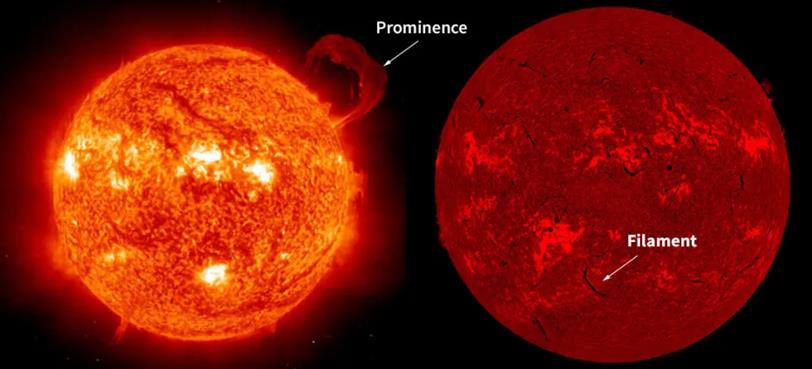
- Large arc of glowing gas
- Anchored by magnetic fields
- Can extend hundreds of thousands of km
- Last for months
