
Study Materials
Union and Its Territory (Articles 1–4)
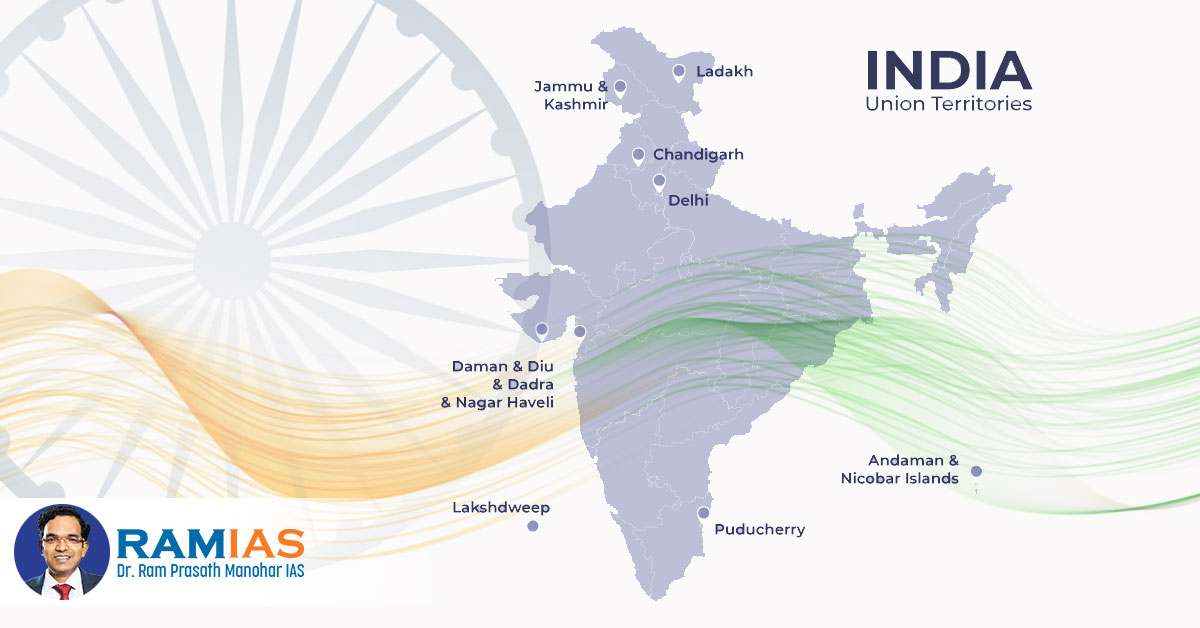
- India as a ‘Union of States’ (Article 1)
- The Constitution describes India, or Bharat, as a Union of States.
- The phrase indicates that Indian states do not enjoy independent sovereignty, nor do they have separate constitutions or citizenship.
- The First Schedule lists the names and boundaries of all 28 states and 8 union territories.
- “Territory of India” is a broader term than “Union of India”:
- Union of India = only states
- Territory of India = states + UTs + any acquired territories
- States share powers within the federal system; UTs are under the direct control of the Centre.
- Special provisions for selected states are provided under Part XXI, and tribal areas are governed by the Fifth and Sixth Schedules.
Debate on the Name of the Country
- In the Constituent Assembly, some members preferred Bharat, others India.
- A compromise led to the wording: “India, that is, Bharat.”
Categories of the Territory (Article 1)
India’s territory is classified into:
- States
- Union Territories
- Acquired Territories
Acquisition of Foreign Territories
- After the Constitution came into force, India added territories such as Goa, Daman & Diu, Puducherry, Sikkim, etc.
Territorial Waters and Maritime Zones
- Territorial waters extend 12 nautical miles from India’s baseline (1976 Act).
- The Exclusive Economic Zone (EEZ) extends up to 200 nautical miles, expanded in 1977.
- Enabled by the 40th Constitutional Amendment and the 1976 Maritime Zones Act.
- Article 2 – Admission or Establishment of New States
Parliament has two powers:
- Admit existing states into the Union.
- Establish new states that did not exist earlier.
- Article 3 – Formation or Alteration of States
Parliament can:
- Create new states,
- Change the area, boundary, or name of any existing state.
Conditions:
- A bill can be introduced only with the President’s recommendation.
- The President must refer the bill to the concerned State Legislature for its opinion (non-binding).
Note: Parliament can also merge parts of states/UTs to form new states/UTs.
Difference Between Articles 2 and 3:
|
Article 2 |
Article 3 |
|
For states not part of India currently. |
For states already within India. |
|
Admission or creation of new external states. |
Alteration or formation of internal states. |
- Article 4 – Not a Constitutional Amendment
- Laws made under Articles 2 & 3 are not treated as amendments under Article 368.
- They require only a simple majority through the ordinary legislative process.
Exchange of Territories
- Berubari Case (1960)
- Question: Can territory be ceded under Article 3?
- Supreme Court: No. Ceding territory requires a Constitutional Amendment under Article 368.
- This arose when India proposed handing over part of Berubari (West Bengal) to Pakistan.
- Radcliffe Line & Enclaves
- The Radcliffe Commission drew the India–Pakistan (including East Pakistan) boundary.
- Left many enclaves (Chitmahals) unresolved.
- India–Bangladesh Land Boundary Agreement (LBA)
- Agreements from 1958 onwards attempted resolution.
- Final settlement through the 1974 LBA.
- Formally implemented by the 100th Constitutional Amendment Act, 2015.
- Result:
- India transferred 111 enclaves to Bangladesh.
- Bangladesh transferred 51 enclaves to India.
Articles 1 to 4 give India a strong but flexible federal structure. They define the Union’s territorial identity, empower Parliament to reorganize states, and provide constitutional tools to resolve boundary issues peacefully, strengthening unity while accommodating diversity.
