
I. Aquatic Ecosystems
Aquatic ecosystems are plant–animal communities occurring in water bodies.
Classification (by salinity):
- Freshwater (<5 ppt)
- Lentic: ponds, lakes, bogs, swamps
- Lotic: rivers, streams, springs
- Brackish (5–35 ppt)
- Estuaries, mangroves, salt marshes
- Marine (≥35 ppt)
- Seas, oceans, coral reefs
II. Wetland Ecosystem
- Wetlands are marshy or peatland areas with static or flowing water, fresh/brackish/saline, including marine waters up to 6 m depth at low tide.
- Act as ecotones (transition zones) between terrestrial and aquatic ecosystems.
Examples:
- Mangroves
- Floodplains
- Lake littorals
- Marshes and swamps
Key Characteristics:
- Periodic flooding or waterlogging
- Hydrophytes (water-adapted plants)
- Hydric soils (oxygen-deficient)
III. Wetlands in India
- Over 27,000 wetlands
- ~23,000 inland
- ~4,000 coastal
- Cover 4% of India’s area
- ~70% under paddy cultivation
- Range from Himalayan high-altitude wetlands to coastal lagoons, mangroves, and coral reefs
IV. Wetlands vs Lakes
|
Feature |
Lake |
Wetland |
|
Depth |
Usually >3 m |
Usually <3 m |
|
Dominant producers |
Phytoplankton |
Macrophytes |
|
Productivity |
Low |
High |
|
Trophic status |
Oligotrophic |
Mostly eutrophic |
|
Flood control |
Limited |
Significant |
|
Food chain |
Grazing |
Detritus |
|
Vegetation |
Sparse |
Abundant |
V. Importance of Wetlands
- Flood mitigation and shoreline protection
- Groundwater recharge
- Water purification & nutrient recycling
- Biodiversity hotspots (migratory birds, fish)
- Climate regulation
- Genetic reservoirs (e.g. rice)
- Support eco-tourism and livelihoods
VI. Causes of Wetland Degradation
- Industrial & domestic pollution
- Agricultural runoff (eutrophication)
- Encroachment & land conversion
- Overfishing & aquaculture
- Invasive species (water hyacinth)
- Sand mining & deforestation
VII. Measures to Protect Wetlands
- Scientific demarcation & legal enforcement
- Treatment of effluents before discharge
- Control of invasive species
- Sustainable aquaculture
- Afforestation & soil conservation
- Community participation
- Eco-tourism with safeguards
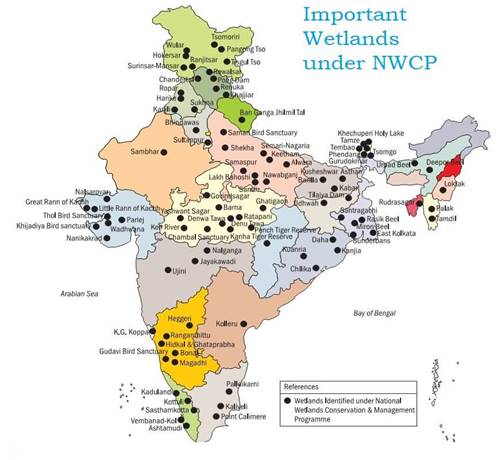
National Wetlands Conservation Programme (NWCP)
- Launched: 1985–86
- Nodal Ministry: MoEFCC
- Wetlands identified: 115 (national importance)
- Criteria: Same as Ramsar Convention
- Centre: Coordination, funding, guidelines
- States/UTs: On-ground management
Objectives:
- Prevent degradation
- Ensure wise use
- Wetland inventory preparation
- Monitoring & evaluation
Ramsar Convention on Wetlands
- Signed: 2 February 1971, Ramsar (Iran)
- World Wetlands Day: 2 February
- Parties: 170
- Core principle: Wise Use
- Maintenance of ecological character within sustainable development
Ramsar Site:
- Wetland of international importance
- Government commitment to conservation
Montreux Record
- Register of Ramsar sites facing ecological threats
- Due to pollution, development, and human interference
Wetlands International
- Global NGO (not intergovernmental)
- Works on research, advocacy, policy support & field action
